Indian brands are no longer local players. Luxury labels like Sabyasachi are dressing global icons. Indian SaaS products power businesses across Silicon Valley. Freelancers from small towns are building apps for clients in Berlin and New York.
India is exporting excellence.
But when international payments return home, a portion of that hard-earned revenue quietly disappears: through high fees, hidden FX markups, failed transactions, and distant, indifferent support from global payment processors.
Our insight: Indian exporters aren’t being scammed; they’re being quietly disrespected. And they’ve accepted it as inevitable.
We set out to disrupt that inertia.
Our objectives were to:
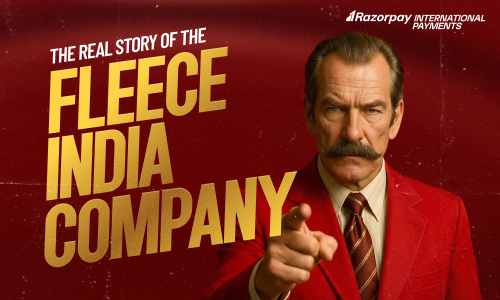
Instead of launching a feature campaign, we created a fictional villain brand: The Fleece India Company, a faceless global payments giant that proudly keeps “just a little extra” from every Indian exporter.
The rallying cry: Get Paid. Not Played.
The ambition wasn’t incremental awareness. It was narrative disruption.
To bring this idea to life, we built an entire satirical cinematic universe using generative AI.
We reinterpreted one of Indian cinema’s most iconic colonial antagonists, Captain Russell from Lagaan, who famously declared “teen guna lagaan” (three times the tax). In our campaign, that archetype returned for the digital economy, now declaring “das guna lagaan” (ten times the tax), symbolizing hidden FX markups, excessive fees, and silent profit extraction from Indian exporters.
Rather than explain cross-border payments through dashboards and feature lists, we visualized exploitation.
Using generative AI, we created hyper-real cinematic frames: exporters pleading for help while calls go unanswered; a foreign “payments overlord” seated in imperial excess; dramatic lighting, colonial architecture, exaggerated wealth, and satirical tropes – including a pet crocodile, gold, and theatrical indifference.
But this was not a one-click generation.
Each frame was the result of layered prompt engineering and iterative refinement.
We used a bunch of AI tools, from Midjourney (to generate frames and render them) and ElevenLabs (for voiceovers) to KlingAI (lipsync) and TopazLabs (Upscale). Understanding where to use which tool in the workflow efficiently was a challenge in itself.
We calibrated facial micro-expressions (smug amusement vs aristocratic contempt vs exaggerated theatrical villainy) and had to frame the shots to reinforce hierarchy and power imbalance.
One unexpected creative challenge was dialogue. We wrote Hindi lines that had to sound like Hindi spoken by a colonial British officer – grammatically correct, but tonally foreign and slightly mis-accented. We needed multiple iterations to balance authenticity with exaggeration.
Another key challenge was emotional continuity. Generative models often struggle with consistent facial identity and nuanced expression across scenes. Maintaining the same face, costume detailing, emotional arc, and environmental tone across a master film and spin-offs required structured prompt templates and controlled iteration loops.
AI enabled us to:
The campaign included:
What would traditionally require large-scale production infrastructure was achieved through directed generative design.
The result was a culturally grounded, visually arresting campaign that transformed invisible financial leakage into a cinematic antagonist.
Financial services marketing often defaults to feature grids, rate comparisons, and technical messaging. We chose satire.
Rather than compete on rate tables, we reframed the category conversation.
In a space dominated by global incumbents, we positioned Razorpay as transparent, India-first and respectful of exporter margins.
By turning invisible financial leakage into a visible antagonist, we shifted cross-border payments from a technical discussion to a fairness discussion.
We didn’t explain fees. We personified them.
“The Fleece India Company” ran from November 19 to December 24, 2025, with a four-week pre-campaign baseline.
As a challenger brand (<1% category share), our objective was to shift perception in a category dominated by global incumbents. The impact extended beyond awareness into measurable growth.
Organic Social Performance: The generative AI–driven creative significantly outperformed benchmarks:
In a category known for feature-heavy messaging, the AI-powered cinematic satire delivered both cultural attention and measurable movement.