Gamers stopped Googling. They started asking ChatGPT which headset to buy, and SteelSeries kept getting left out of the answer.
Despite strong traditional SEO and genuine brand authority in gaming, SteelSeries had an inconsistent presence across AI search platforms. Competitors were claiming territory in this emerging channel while SteelSeries went unmentioned for high-intent queries like "best gaming headset" or "best gaming keyboard."
The goal was to establish category dominance across ChatGPT, Gemini, Perplexity, Google AI Overviews, Amazon Rufus, and AI Mode Shopping, then prove it drove real business results above just vanity metrics.
We also saw an opportunity that most brands were ignoring entirely: AI agents are beginning to make purchasing decisions on behalf of consumers. Winning in AI search also meant preparing SteelSeries for agentic commerce. That meant optimizing product feeds, product detail pages, and technical infrastructure for surfaces where the buying decision happens before a human ever clicks.
AI search operates differently from traditional search. Models synthesize from multiple sources, rank based on citation authority, and generate original recommendations. There are no fixed rankings, and visibility is probabilistic. That changes what optimization means and where effort has to go.
The first thing research revealed was counterintuitive: a small cluster of review sites and Reddit threads drove the majority of AI citations for gaming hardware. Optimizing owned content alone wouldn't move results. We needed to win across owned, earned, and social surfaces simultaneously, and we needed to treat AI models as the actual audience we were designing for.
Content work started with product pages. We added Q&A sections, structured summaries, and citation-ready phrasing. Answer boxes near page tops addressed core questions in 40-60 words. FAQ schema covered the conversational queries AI models fielded most often.
On the technical side, we implemented structured data across all relevant pages, including Product, FAQPage, HowTo, Article, and more, resolved server-side rendering issues that were blocking AI crawlers, and added LLMs.txt to give crawlers structured guidance through the site.
Earned media required a different approach. Using Goodie AI's platform, we identified which specific publishers AI models actually cited for gaming hardware queries, then ran targeted outreach to update stale mentions and replace outdated coverage. Monitoring also surfaced lingering references to older product lines carrying negative sentiment, and we coordinated content updates and review refreshes to correct the record.
Reddit appeared frequently in AI citation sets for gaming hardware. Rather than promotional content, we contributed genuinely useful responses to relevant conversations, building an authentic presence in the threads AI models actually retrieved.
The agentic commerce work was the piece that set this apart most clearly. We optimized product feeds for ChatGPT Shopping, Amazon Rufus, and AI Mode Shopping before most competitors knew these channels existed. Data was structured for agent parsing, not just human reading, and feeds were submitted to commerce protocols early.
Throughout, Goodie AI's platform provided real-time monitoring across all target LLMs, tracking mentions, sentiment, competitive share of voice, and AI crawler activity. GA4 integration tied AI visibility to actual traffic and conversions, making the business case concrete.
The main challenge was that the playbook didn't exist yet. There was no established framework for agentic commerce readiness in gaming hardware. Every tactic required reasoning from first principles about how AI models retrieve, cite, and recommend, then building the infrastructure to influence that process systematically.
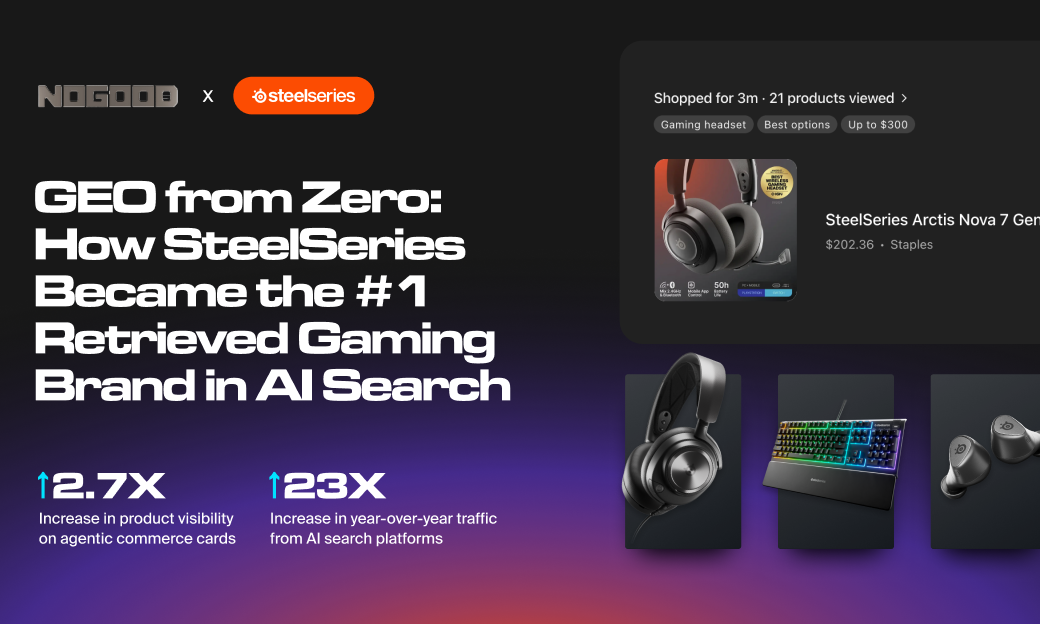
Ten months in, SteelSeries went from an inconsistent AI presence to the #1 retrieved gaming brand for headsets, keyboards, and earbuds across ChatGPT, Gemini, and Perplexity.
Visibility scores improved significantly across every platform: Gemini from 62 to 85, ChatGPT from 51 to 73, Perplexity from 44 to 77, representing a 6.3X increase in overall brand visibility across tracked AI platforms. Product visibility on agentic commerce cards grew 2.7X, with SteelSeries products surfacing consistently in AI shopping recommendations for high-intent purchase queries.
The traffic and revenue impact matched. AI search traffic grew 23X year-over-year, reaching over 1,500 daily visitors by October 2025. Conversions from AI platforms grew 27X year-over-year. Revenue from AI search increased 3.7X, and conversion rates from AI traffic outperformed traditional search benchmarks.
These results met every objective we set out to achieve: category leadership across AI search, proven agentic commerce presence, and clear revenue attribution. What makes the effort a success is the compounding position SteelSeries now holds. AI platforms reinforce existing authoritative citations, which means early movers build advantages that get harder to close over time. Competitors are moving in, but SteelSeries is already the default recommendation. Try it for yourself: ask the AI of your choice, “What is the best gaming headset?”
This campaign proved GEO can be a measurable, attributable revenue driver and created a replicable blueprint for how to build that position from scratch.