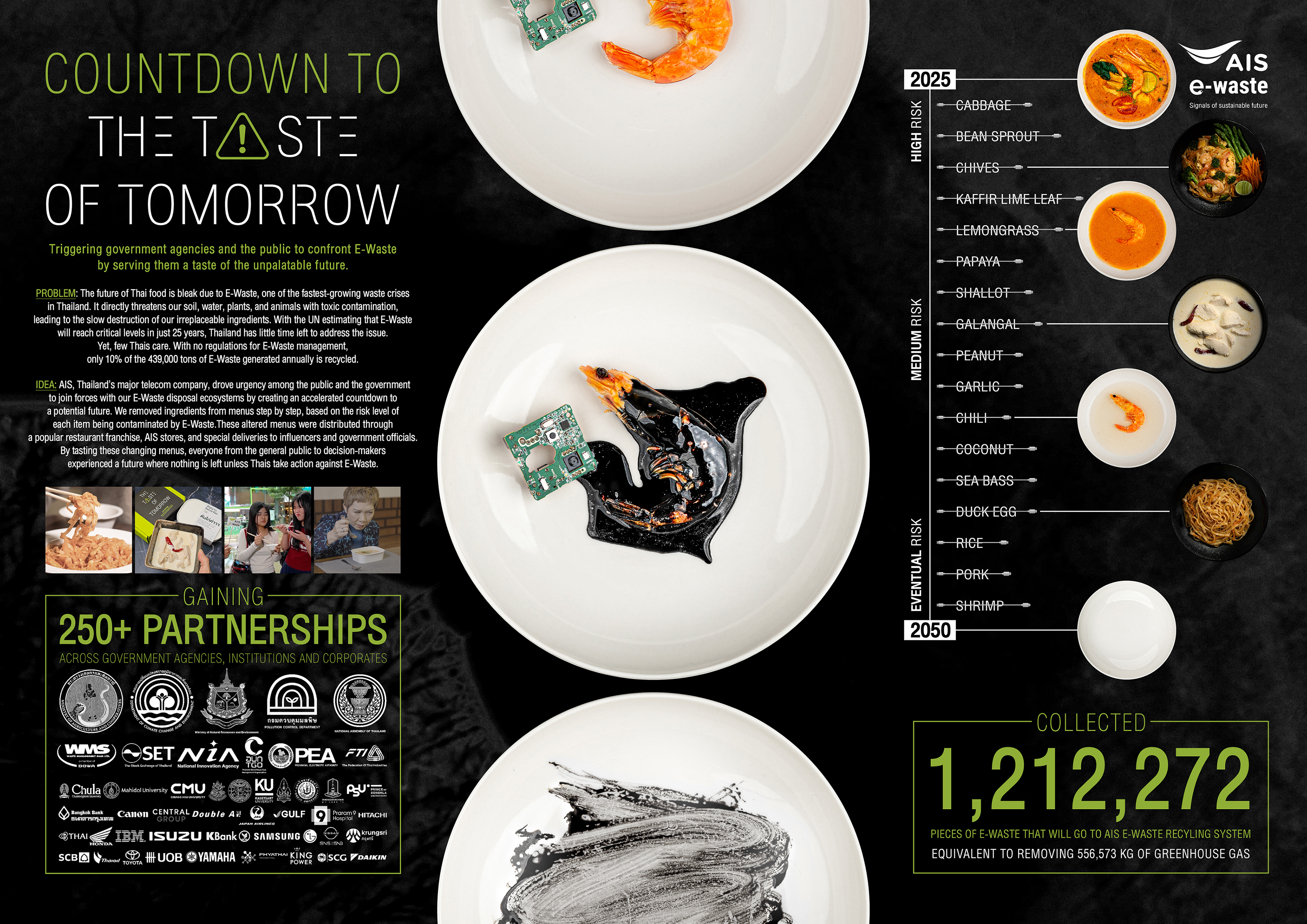
Despite being an agricultural country, Thailand is ignoring E-Waste which is a major threat to Thai ingredient. Only 10% of the annual 439,000 tons is properly recycled due to the absence of national regulation. Furthermore, most Thais lack clear understanding on the effect of E-Waste, and view the issue as a non-urgent threat.
As a major telecom provider contributing to the E-Waste problem, AIS has established an E-Waste management system. To create a sustainable future for Thai environment and our food sources within the limited time frame, AIS set out to leverage the company’s E-Waste recycling system into a national agenda.
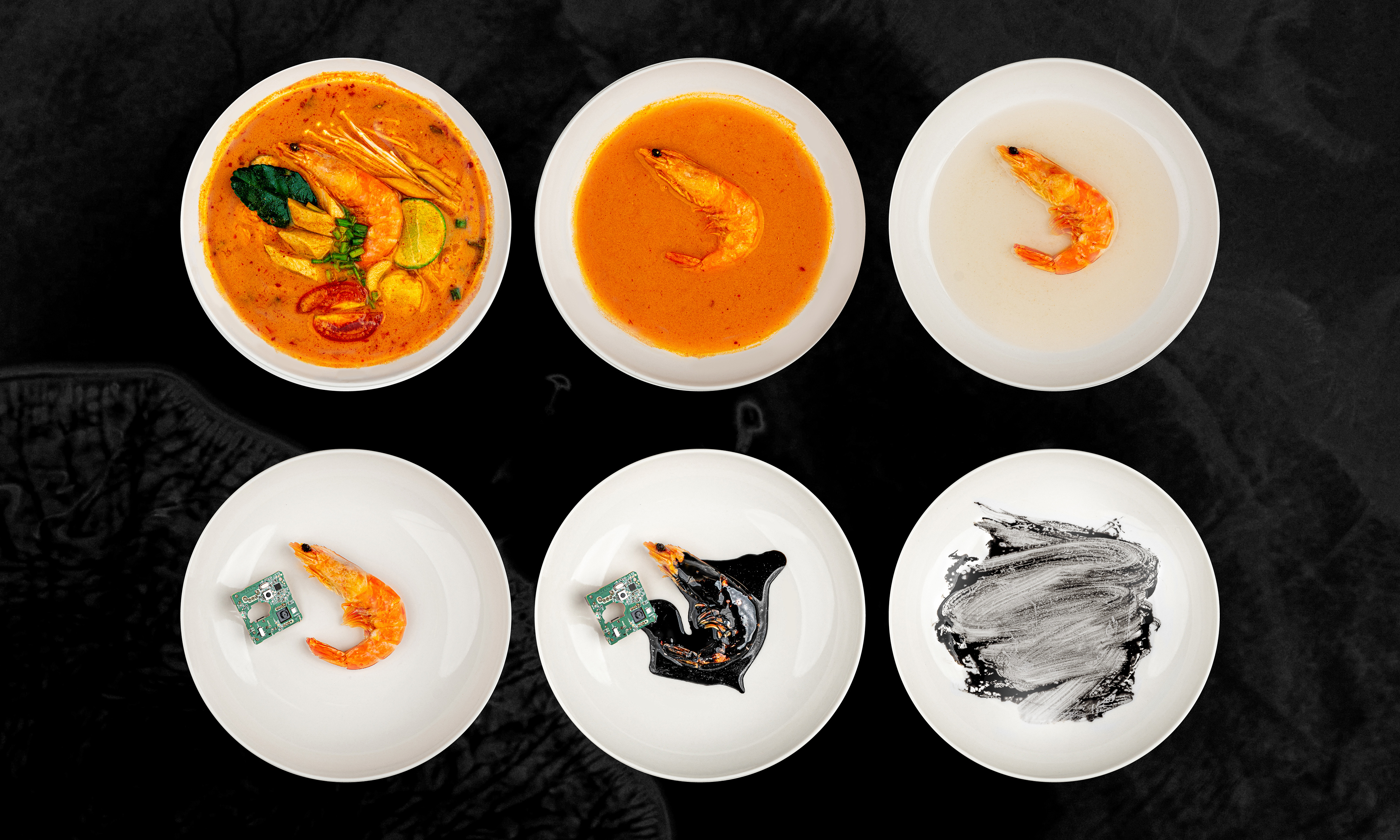
“Countdown to the Taste of Tomorrow” was created to visualize the threat of the long ignored problem by literally giving people a taste of the potential future that E-Waste would create. To demonstrate the idea of a ‘countdown’, we removed ingredients from famous menus step-by-step based on their risk of contamination.
The “Taste of Tomorrow” menus were distributed through restaurant franchises, AIS store, and direct deliveries to influencers and government officers. By visualizing the loss of beloved dishes, we forced a realization: without proper E-Waste disposal, our tastes will disappear.
The goal is to get Thais to recognize the importance of AIS’s E-Waste recycling system, and encourage partnerships beyond the general public. In the absence of national regulation, AIS aimed to form a voluntary cross-sector network including government agencies that could expand E-Waste drop-off stations beyond AIS stores, and drive systematic changes in dealing with E-Waste.
Our strategy centered on bringing the future impact of E-Waste into the present. The “Taste of Tomorrow” menus visualized a statistical warning as a sensory countdown that is easily understood and relevant to everyday life and governmental agendas.
To secure collaboration from the public, government agencies, and corporations, we selected menus with dual relevance. Modern favorites like Thai BBQ from the popular franchise “BBQ Plaza” were selected to engage younger generations and demonstrate to corporations how they could join AIS’s E-Waste management ecosystem. Iconic dishes like Tom Yum were chosen to capture the attention of older generations and government agencies who promoted them.
We launched by delivering “The Taste of Tomorrow”, changed versions of the “Soft Power dishes” Tom Yum Goong and Pad Thai, to political figures, sparking immediate dialogue and collaboration promises.
Simultaneously, we brought the future taste to the public through a partnership with BBQ Plaza, removing their beloved sliced cabbage from selected branches. Servers informed surprised customers the ingredient was “lost to E-Waste”.
To sustain momentum, we delivered other changed dishes to food and IT influencers over the following months, visualizing the widening crisis and keeping the conversation alive online. Removing key ingredients resulted in unpalatable tastes that triggered reactions from Thais who are used to full-flavor dishes, creating content that translated well across social media.
At AIS store, we escalated the countdown by distributing menus with more missing ingredients, capturing real-time reactions for later social contents.
The campaign culminated in a video showing the final stage of the countdown: an empty plate, the ultimate future of inaction. Materials directed people to AIS E-Waste disposal points and the website where new partnerships could be formed.
By turning the abstract threat of E-Waste into a tangible, tastable loss, AIS successfully elevated the ignored crisis into a national priority fitting for a food production country.
We triggered a domino effect of collaborations, securing 250+ partnerships to create a massive nationwide E-Waste ecosystem. This coalition united the government bodies responsible for Thailand's food and environment, including the Ministry of Agriculture, Ministry of Natural Resources and Environment, Pollution Control Department, National Innovation Agency and The National Assembly of Thailand, with global industry giants like Samsung, Honda, and IBM, and leading academic institutions across Thailand like Chulalongkorn University, Mahidol University and Chiang Mai University.
This alliance, alongside an alerted public, sparked behavior change. AIS collected 1,212,272 pieces of E-Waste, successfully diverting toxic materials from the soil and water that feeds the nation. This massive cleanup is equivalent to reducing 556,573 kg of greenhouse gas or planting 46,380 trees.
With 3.5 million views and 365,000 engagements for online contents, the campaign moved beyond awareness to establish a functional network that can save the ingredients of today. We turned a corporate initiative into an expanding national cross-sector collaboration that keeps the recycling effort active and growing.