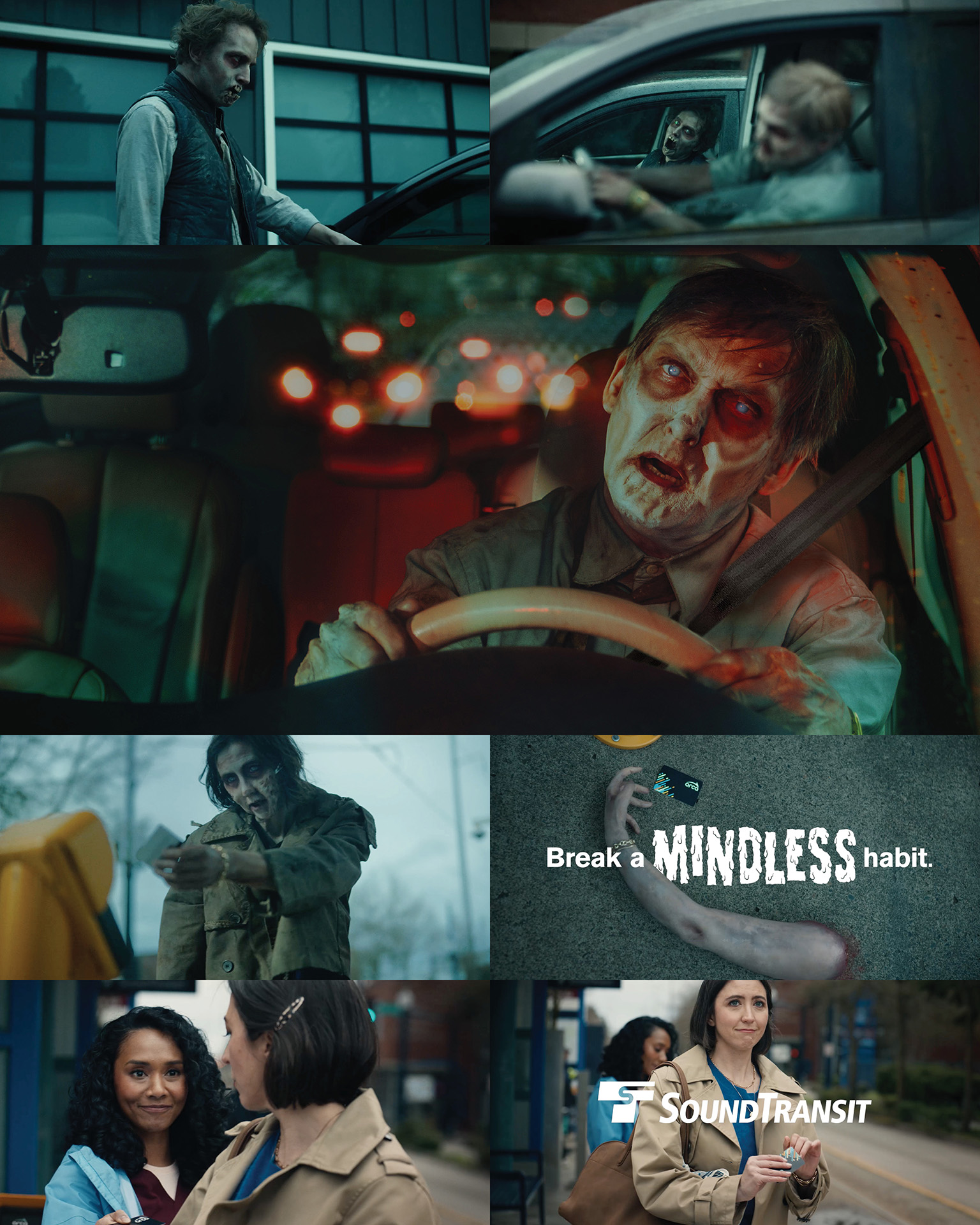
Despite rising gas prices, worsening congestion, and escalating parking fees, many Seattle residents continued to default to driving out of habit rather than necessity. Sound Transit's expanded light rail service could provide a solution. But it would require a chance in how people think about getting around Seattle.
The objective of this campaign was to build awareness, goodwill, and usage across all Sound Transit services, extending the momentum of the successful 1 Line expansion and the launch of the new 2 Line. The broader goal was behavioral: encourage people to break free from total car dependency and reconsider how they move through their city.
By identifying and naming a familiar but unexamined condition—“car-brain”—Sound Transit sought to reframe driving not as the obvious solution, but as an avoidable source of stress. The campaign positioned public transit as a smarter, calmer, and more flexible alternative that gives riders back time, money, and peace of mind.
The strategy began with a simple human truth: people don’t always choose the best option—they choose the most familiar one. In Seattle, that meant countless commuters enduring traffic, parking fees, and stress without ever questioning whether driving was actually the right choice.
To break that cycle, Sound Transit introduced the concept of “car-brain”—the mindless default to driving, even when it clearly isn’t working. Creative execution focused on dramatizing the everyday horrors of car dependency and contrasting them with the freedom and flexibility Sound Transit offers. Rather than positioning transit as a replacement for cars, the campaign framed it as an expanded mobility toolkit—one that lets riders mix and match modes based on what makes the most sense for their day.
One of the key challenges was overcoming deeply ingrained habits. People may support public transit in theory while still driving in practice. By centering the campaign on shared frustration rather than policy or infrastructure, Sound Transit made behavior change feel personal, achievable, and immediately rewarding.
The idea gained traction beyond traditional media, taking on a life of its own. Public response and buzz even led to a limited-time swag drop—an uncommon occurrence for a transit authority—demonstrating how strongly the concept resonated throughout the region.
The campaign delivered results that exceeded expectations and validated its behavior-changing ambition.
Overall Sound Transit ridership increased 23% year-over-year, with more than 23 million riders choosing car-free transportation across Sound Transit’s network. Link light rail ridership saw a 127% increase during the first month of the campaign, signaling immediate impact and adoption.
The newest addition to the system, the 2 Line, experienced a 63% year-over-year increase in ridership, demonstrating that awareness could translate quickly into real-world usage.
Beyond ridership metrics, the campaign generated significant buzz and cultural relevance, helping reposition Sound Transit as a modern, user-friendly alternative to driving. The widespread recognition of “car-brain” proved the campaign successfully tapped into a shared frustration while at the same time offering a compelling way out.
By reframing public transit as a lifestyle upgrade rather than a sacrifice, Sound Transit helped more people break free from habitual driving and embrace a better way to get around the Puget Sound.