Many Native Americans rely on Indian Health Services for medical care. When clinics are closed, stretched too thin, or patients are far from home, getting care can be difficult and costly. The challenge for this campaign was to communicate to Native American communities across New Mexico that health insurance through BeWell, New Mexico’s Health Insurance Marketplace, supplements Indian Health Services (IHS) benefits, while supporting the primary goal of increasing enrollment through BeWell among Native Americans. Most Native Americans qualify for no-cost coverage and can enroll in a plan any time, not just during open enrollment, making BeWell a critical access point to care.
For this audience, health insurance is especially difficult to navigate due to multiple layers of awareness combined with deep-rooted skepticism. Many Native Americans are unaware that they can obtain private health insurance at no cost through BeWell, outside of employer coverage. Fewer understand that this coverage does not replace IHS but instead extends its resources and fills gaps in care. Even fewer realize enrollment is available year round with free, accessible assistance. Combined with geographic isolation and justified skepticism shaped by historic trauma and systemic inequities, these overlapping barriers created a uniquely complex marketing challenge: educating across multiple levels of understanding while simultaneously building trust and motivating enrollment.
Insights for this campaign were informed through a layered discovery process using both primary and secondary research. We conducted an independent deep dive into IHS to understand how care is accessed nationwide, including its historical development, eligibility requirements, and the systemic factors shaping care delivery today. This analysis helped clarify why insurance through BeWell meaningfully extends IHS services and resources and why distrust of the healthcare system exists.
To further inform strategy, we analyzed prevalent health challenges within Native communities, identifying gaps and motivators relevant to healthcare decision-making. We also leveraged qualitative insights from focus groups, which revealed awareness gaps and perceived barriers to enrollment among uninsured populations. These findings were supplemented by performance data and learnings from previous BeWell campaigns targeting Native American audiences in New Mexico.
Insights from this research were synthesized into detailed audience personas to guide strategy, messaging, and channel selection. During creative development, campaign concepts were shared with Native audiences and community-connected stakeholders for feedback, allowing for iterative refinement to ensure cultural relevance, clarity, and trust.
The plan for this campaign was to address two interconnected challenges: limited awareness of how health insurance through BeWell works in relation to IHS and tribal health, and longstanding skepticism toward the broader healthcare system. Many Native Americans were unaware that enrolling through BeWell does not replace or alter their relationship with IHS, but instead expands access to care while helping bring more funding to tribal health systems. Even when awareness gaps were addressed, historical trauma, systemic inequalities, and prior experiences with healthcare institutions continued to influence trust and decision-making. The primary objective of this campaign was to increase enrollments through BeWell among Native American throughout New Mexico, and the primary target audience was uninsured and underinsured Native Americans across New Mexico.
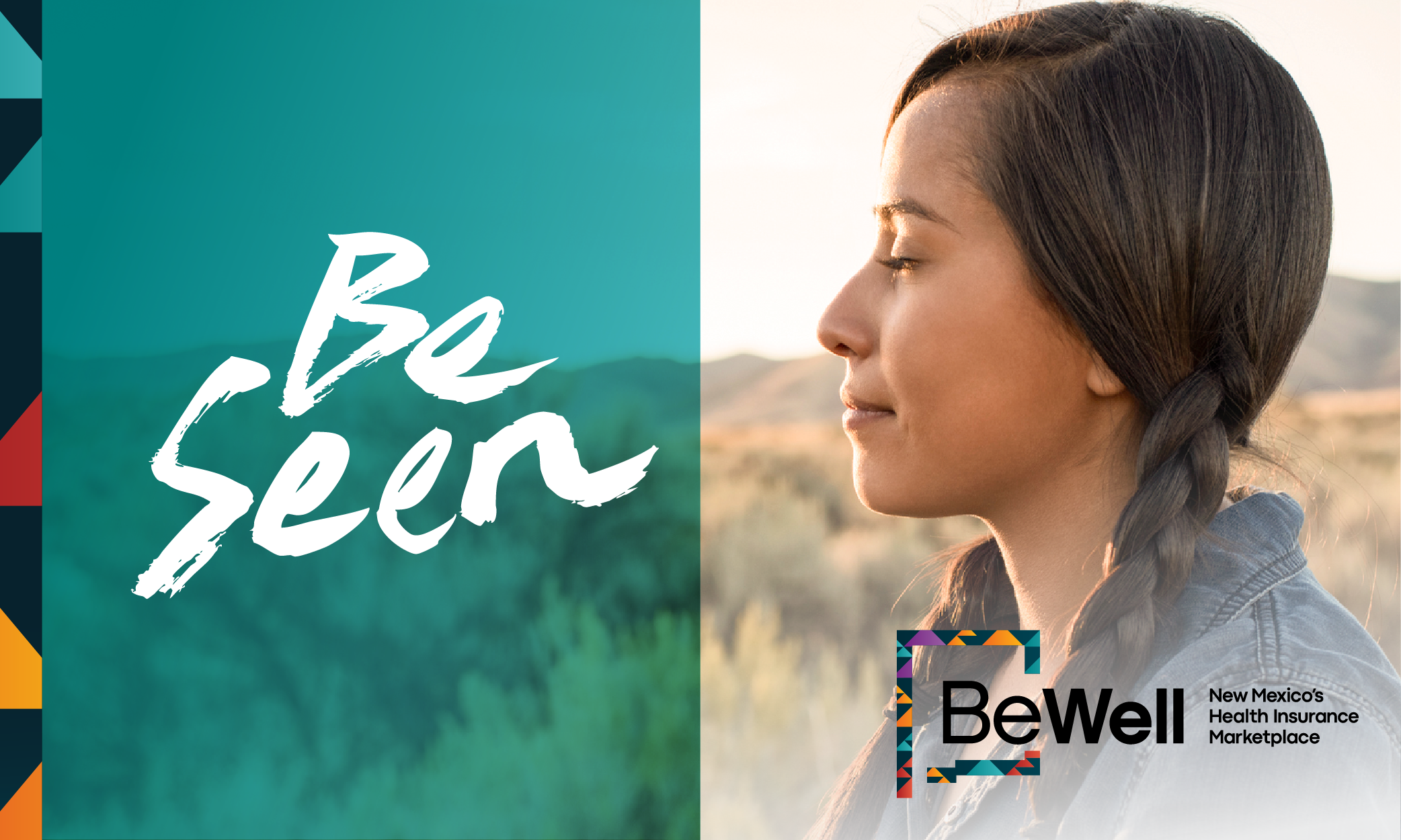
The plan centered on delivering clear, layered education through authentic storytelling. The Be Seen creative concept acknowledged the real barriers many Native people face when accessing healthcare, such as distance, limited availability, and system complexity, while positioning BeWell as a supportive resource individuals could choose to use when and where they needed care. Creative planning prioritized real, joyful, and honest moments reflective of Indigenous communities across New Mexico to establish trust and relatability.
Execution began by leveraging Native American-specific brand elements developed during BeWell’s rebrand to ensure every touchpoint was culturally relevant and authentic. We collaborated with community-connected voices and used photography and video of Native Americans throughout New Mexico, capturing organic moments within their communities rather than staging content solely for the campaign.
The centerpiece of the campaign was a 60-second broadcast and digital video that acknowledged the barriers many Native people face in accessing healthcare and daily life, framing BeWell as a trusted resource for expanding access to care.
Print placements served as the primary educational vehicle, while digital and retargeted ads reinforced simplified calls to action such as “Get free help signing up for health insurance year round.” The campaign was executed across English and Diné radio, print, out-of-home, and hyper-focused geotargeted digital media.
Campaign performance was evaluated using both enrollment data and engagement metrics. BeWell provided enrollment data related to Native Americans, recognizing that this information was based on self-reported race and ethnicity. To supplement this, campaign metrics were tracked and reported monthly and used to optimize performance in real time.
The campaign delivered more than 17.5 million impressions, over 10,000 website clicks, and click-through rates 238 times industry benchmarks. It also generated more than one million completed CTV views, achieving an average $12.76 CPM, and secured 30% added value across TV and radio. These engagement results validated the original strategy, indicating that messaging and visuals resonated with the intended audience and prompted action.
Most importantly, BeWell reported an 42% enrollment increase among self-identified Native Americans in 2024/2025, demonstrating that the campaign successfully translated awareness, education, and trust into measurable outcomes aligned with campaign objectives.