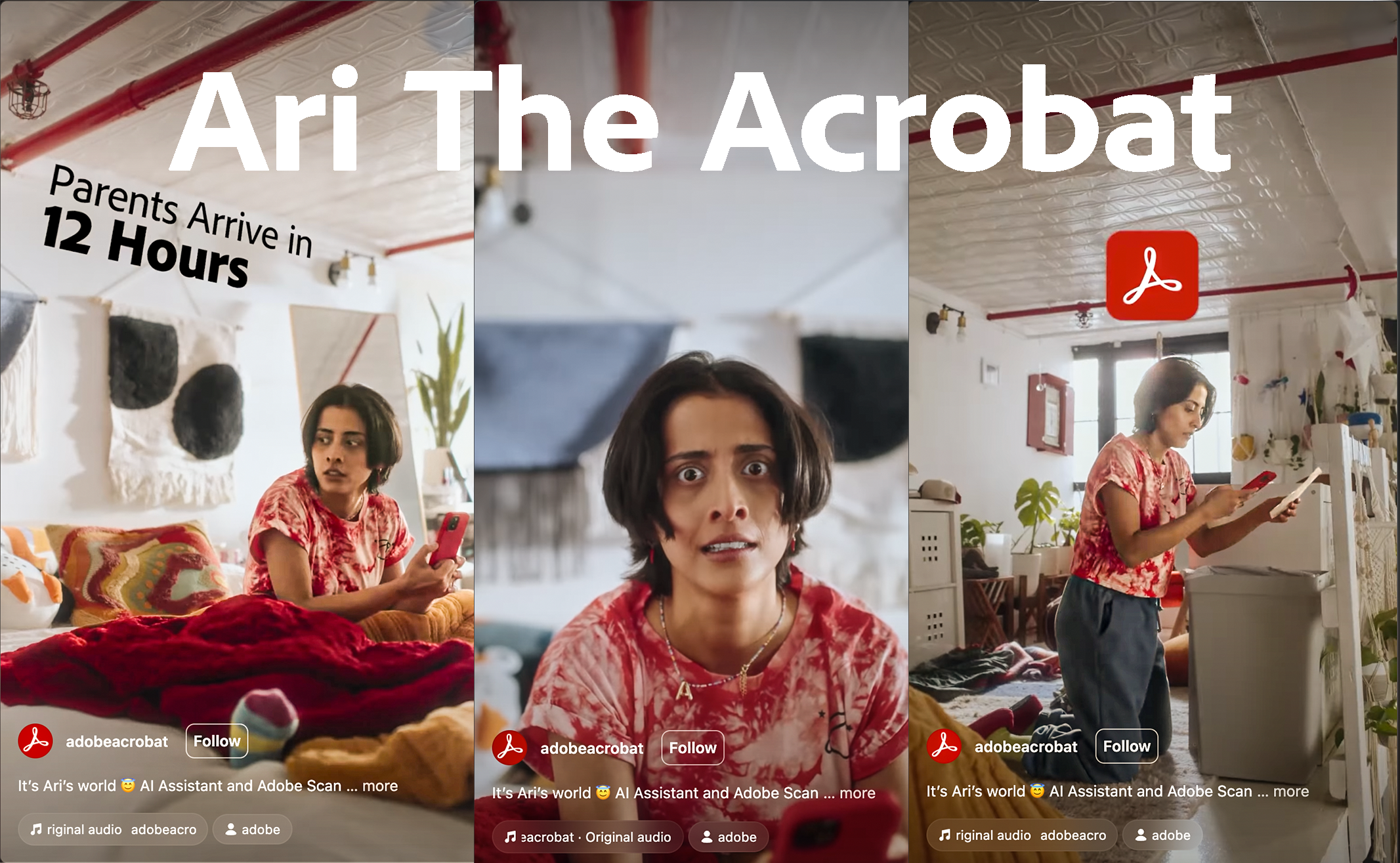
Ari the Acrobat was created to make Adobe Acrobat feel human, entertaining, and culturally relevant, not like traditional enterprise software. The idea driving the campaign was simple: if Acrobat helps people keep their balance through work and life, why not show that through a character who’s literally doing acrobatics?
Instead of relying on feature demos or corporate messaging, the campaign introduced Ari, a recurring social character navigating everyday professional and personal moments - contracts, confidence, awkward situations, early mornings, and cultural disconnects. Through Ari’s story, Acrobat’s AI and productivity features became a supporting character, quietly helping Ari stay on track.
The primary goals were to:
Secondary goals included building repeat viewership through a recognizable franchise, encouraging saves and shares, and humanizing Acrobat for working professionals and students entering the workforce.
Ultimately, Ari the Acrobat aimed to prove that productivity tools can be entertaining, and that humor and storytelling are powerful ways to build brand affinity.
The campaign was executed as a social-first editorial series, with eight installments released between January and August 2025. Each post functioned as a short “episode” in Ari’s ongoing story, allowing audiences to recognize the character and anticipate future moments.
During our execution approach, content was optimized for short-form social performance, primarily through Instagram Reels and posts. Each piece leaned into humor, relatability, and cultural moments, rather than explicit product education. Acrobat features like AI Assistant, PDF editing, and mobile access were embedded naturally into the narrative rather than introduced upfront.
For the creative structure, we wanted Ari’s personality to stay consistent: capable, slightly chaotic, and always moving. Scenarios reflected real-life stressors: contracts on the go, confidence moments, awkward situations, and generational language gaps. Visual overlays and UI cues were used sparingly to reinforce product value without breaking immersion.
What made it unique was how the campaign treated Acrobat like a sidekick, not the hero. It favored entertainment over instruction, trusting the audience to connect the dots. The episodic format gave the work a sitcom-like rhythm, which is arguably rare for productivity software marketing.
We were challenged to balance humor with clarity, which we solved by grounding jokes in real workflows. Some believed it would be difficult to sustain interest in the series over time, so we solved this with a recognizable character and episodic cadence that didn’t fatigue audiences. The number one issue we knew we needed to avoid was getting bogged down by a dreaded overly corporate tone, which we neatly sidestepped by letting Ari’s personality lead every moment. The result was productivity software content that felt entertaining, (dare we say it) cool, and native to social feeds while still communicating meaningful product value.
Ari the Acrobat met its objectives by driving strong engagement, repeat viewership, and positive audience sentiment over an extended campaign window. The series generated 5.7 million total interactions and 5.7 million views, with 47.9K engaged interactions, demonstrating sustained attention across episodic content. In addition, the campaign drove 20.8K link clicks, signaling audience interest beyond passive viewing.
Audience response consistently reflected high relatability. Viewers tagged friends, referenced their own work and life experiences, and engaged with Ari as a recognizable character rather than branded content. The episodic format encouraged return engagement over time, proving that character-led storytelling can sustain momentum across months, not just moments.
By integrating AI Assistant and Acrobat tools organically within the narrative, the campaign increased awareness of underutilized features while maintaining an entertainment-first approach. The success of Ari the Acrobat reinforced that productivity software doesn’t have to be boring to be effective and that humor-driven, social-first storytelling can drive meaningful engagement and brand affinity at scale.