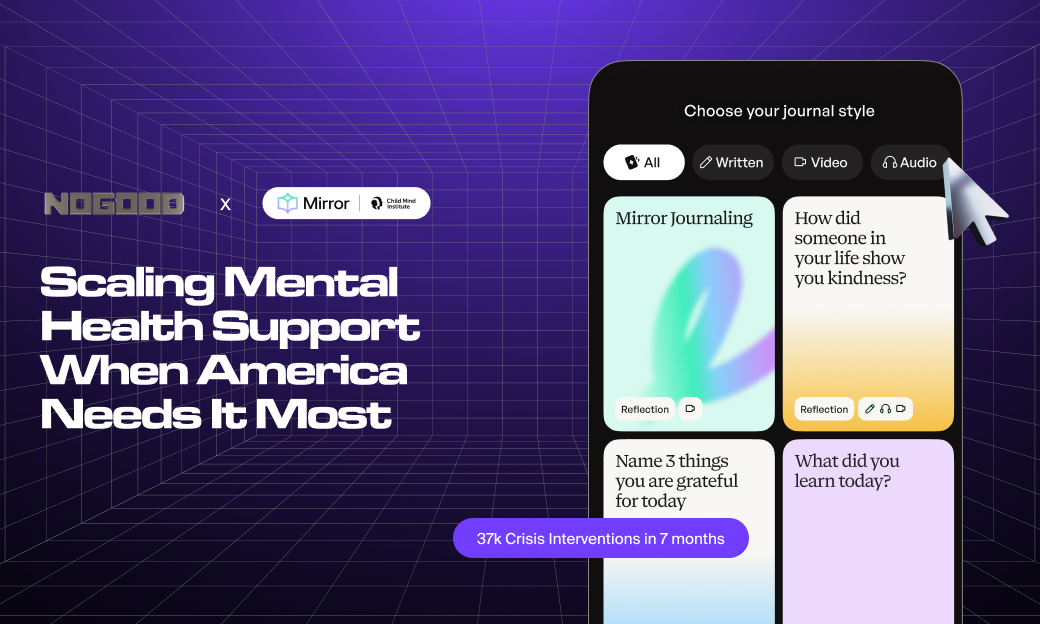
America's mental health crisis has reached a breaking point. One in five young people experiences mental illness, teen suicide rates have surged 57% over the last decade, and 60% of those struggling never receive treatment. The barriers are well-documented: therapy sessions costing $100-200, waitlists stretching months long, and the courage required to ask for help.
The market was already flooded with mental health apps, most behind paywalls, most abandoned. Ninety percent of mental health apps are deleted within 30 days by users who found them shallow or unhelpful when they needed support most.
Mirror launched as something different. Developed by the Child Mind Institute in partnership with California's Department of Health Care Services, it is completely free, clinically backed, and built around evidence-based intervention rather than simple mood tracking. Our objective was clear: reach 50,000 people with accessible mental health tools by June 2025, creating a real alternative when therapy is not an option.
The challenge went beyond user acquisition. We needed to identify who needs this support most through behavioral data rather than demographic assumptions, and prove that clinical interventions can scale through digital channels without losing therapeutic integrity. Mirror needed to be there during the hardest moments: the 2 AM journal entries, the days when getting out of bed feels impossible, the moments when someone needs somewhere safe to put what they are carrying.
This campaign would test whether purpose-led marketing could deliver genuine mental health support at scale, not just downloads.
We launched with a clear hypothesis: teens and young adults needed Mirror most. Initial targeting focused ad spend on Gen Z audiences across Meta, TikTok, and Google. Then the data arrived and challenged everything.
There were 300 active users over the age of 75. Gen X was not just trying the app; they were the most retained cohort, outperforming both Gen Z and Millennials in four-week retention. Women aged 35-44 were journaling two to three times daily with extraordinary retention patterns.
We made the decision to follow the data, and it rippled through every aspect of the strategy.
We shifted 60% of paid media spend away from exclusive Gen Z targeting, expanding age ranges toward audiences showing the strongest retention signals. Teen outreach remained a priority, but this reallocation ensured every dollar reached more of the people who needed Mirror most. Messaging evolved from teen-specific pain points to universal mental health struggles, leaning into Mirror's core differentiator: being there during the moments that matter, regardless of who you are.
The data also revealed something important about how therapeutic impact concentrates. Five percent of users generate 60% of Mirror's documented mood improvements. This power-user cohort averages 57 reflections each, with 79.67% four-week retention. Clinical benefit was not evenly distributed; it concentrated among people who found deep, sustained value in Mirror as a therapeutic tool.
As usage intensified, we recognized our responsibility when people processed their most vulnerable moments. Mirror built algorithmic detection for mentions of self-harm and suicidal ideation, surfacing crisis support resources and creating direct connections to Crisis Text Line and the 988 Suicide and Crisis Lifeline. Support infrastructure was not an afterthought; it was central to the campaign's integrity.
With a limited budget, channel efficiency was critical. Google delivered the highest registration volume at the lowest cost per registration, while Meta and TikTok provided incremental scale that reduced over-reliance on any single channel.
The strategy came down to one principle: follow need, not assumptions. Reach the people who drive real therapeutic impact, build the safety infrastructure to support them responsibly, and prove that free, clinically backed support can hold its own in a saturated market against paid alternatives.
From March to October 2025, Mirror reached 100,000 users in eight months, doubling its original target ahead of schedule. By end of year, that number grew to 139,000. But user acquisition was never the real measure of success.
Crisis intervention: Across 2025, 2,922 people reached out to support services through Mirror, with 1,999 connecting directly to Crisis Text Line. Based on Crisis Text Line's own data showing that 5-10% of reach-outs involve active suicide attempts, an estimated 100-200 of those connections occurred during life-threatening moments. Mirror created the bridge that got people there.
Proactive safety: Mirror's algorithms detected concerning content and surfaced 66,130 crisis support cards to users processing their hardest moments, ensuring no one faced them completely alone.
Therapeutic impact: Users logged 97,000 documented mood improvements, measurable instances where someone journaled through negative emotions and recorded feeling better on the other side. Traditional therapy runs $100-200 per session. Mirror delivered those moments at zero cost.
Retention: Among the most deeply engaged users, Mirror achieved 79.67% four-week retention, proving that free, clinically backed support can keep people coming back because it actually helps.
Real impact does not follow demographic assumptions. It follows need. Mirror proved that purpose-led marketing can deliver genuine mental health support at scale when you are willing to follow the data, even when it challenges everything you thought you knew about your audience.