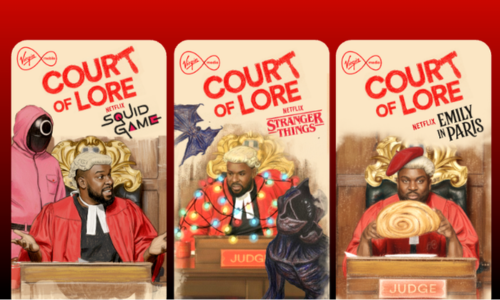
When most people think of Virgin Media, they think of them solely as a broadband provider. But that's not all Virgin offers. In Q1 of 2025, we discovered that only 17% of consumers thought of Virgin as a TV provider, in comparison to 43% citing Sky. Our objective was clear: in order to acquire new customers and better cross-sell services, we needed to drastically increase awareness that Virgin Media "does" TV," by forcing the brand to become top of mind for entertainment.
Fortunately, we had the ammunition to fight back. First, a killer competitive offer: Free Netflix for Virgin Media customers. This partnership gave us the license to finally stop talking about the dry calculus of "Price Per Megabyte" and start talking about something people actually love - TV.
The question was where to have that conversation. It became obvious that the best place to talk about TV was where it is actually debated: social media. With 59% of Gen-Z saying that conversations on social media can influence what they watch, we realised we couldn't just push ads at them; we needed to pull them in through the cultural zeitgeist.
Our primary objectives were to:
Strategy: While our competitors were flooding feeds with clipped scenes and recycled trailers, they were missing the behaviour that actually powers conversation about their shows on social: fandom commentary.
Social isn’t just about what happens in shows, it’s about people’s perspectives on what happens. It’s where allegiances are sworn (Team Jeremiah vs Team Conrad), where theories spiral, and how hot takes harden into doctrine. Culture is built through POV: the Oscar snubs people won’t shut up about, the unhinged video essay explaining why Godfather Part II clears the original, actually.
Our guiding insight was simple: Shows give you the plot. Social gives you the POV.
Instead of talking at fans, we set out to think like them. We went deep: Reddit rabbit holes, binge-fuelled sleuthing, Substack essays, Discord debates. Netflix loved the idea of putting fandom first, and partnered with us to champion the conversations already bubbling beneath their biggest upcoming shows: Stranger Things, Squid Games and Emily in Paris.
The IDEA: Virgin Media Court of Lore.
To win credibility, we couldn't just interrupt the conversation; we had to host it. Enter The Virgin Media Court of Lore: a digital tribunal designed to settle the internet’s fiercest pop-culture disputes in real-time. We created three 90 second videos on TikTok, Instagram and YT shorts, where the core VM audience are. These also live on influencer channels and have paid support to extend their reach.
Timing was our secret weapon. We synchronised our docket with show releases, dropping episodes precisely when cultural heat was peaking during the press junket window. But where others got lost in the "junk of the junket", churning out generic content about actor chemistry or asking, "What did you steal from the set?", we subverted the format. We scraped Reddit threads and deep-dive forums to identify the specific theories fans actually cared about.
Execution: Casting for Chemistry. To ensure the debate felt authentic rather than scripted, the casting had to be perfect. We bypassed standard actors and cast the dynamic duo, influencers Kyra and Axel as our Judge and Clerk. Chosen for their pre-existing chemistry and natural, debate-heavy rapport, they provided the "social glue" and comedic timing needed to hold the court together. As well as helping get eyes on content with their combined following of 2million across both platforms.
For the Defendants, we scoured the internet to hunt down genuine super-fans, creators who were already deep in the trenches of these specific fandoms. These "chaos agents" brought the raw passion and granular knowledge necessary to elevate the conversation from a marketing stunt to a genuine fan debate. Together, they litigated deep-cut topics like the "Ultimate Monster" hierarchy in Stranger Things (Demogorgan vs. Demobat) and the fashion crimes of Emily in Paris.
Our biggest challenge was avoiding spoilers. Rightly so, Netflix wouldn’t let us give these detective-like fans any easter eggs, but we wanted theories that people actually cared about, rather than gimmicky, brand-led, watered-down versions. We had to walk that line without giving anything away.
The Verdict is In. We set out to establish Virgin Media as an entertainment destination, and the Virgin Media Court of Lore content in partnership with Netflix helped us successfully do so by positioning us as a facilitator of entertainment conversations in social. The key performance highlights were:
In the court of public opinion, we didn't just get a fair hearing, we got a standing ovation. The jury has spoken, and Virgin Media is officially guilty... of being entertaining (about entertainment). The success of this series has inspired us to double-down on our position as the host of TV debates, and we’ve even had interest from other programming partners to add fuel to the flames of their fandoms too. So, stay tuned for more…