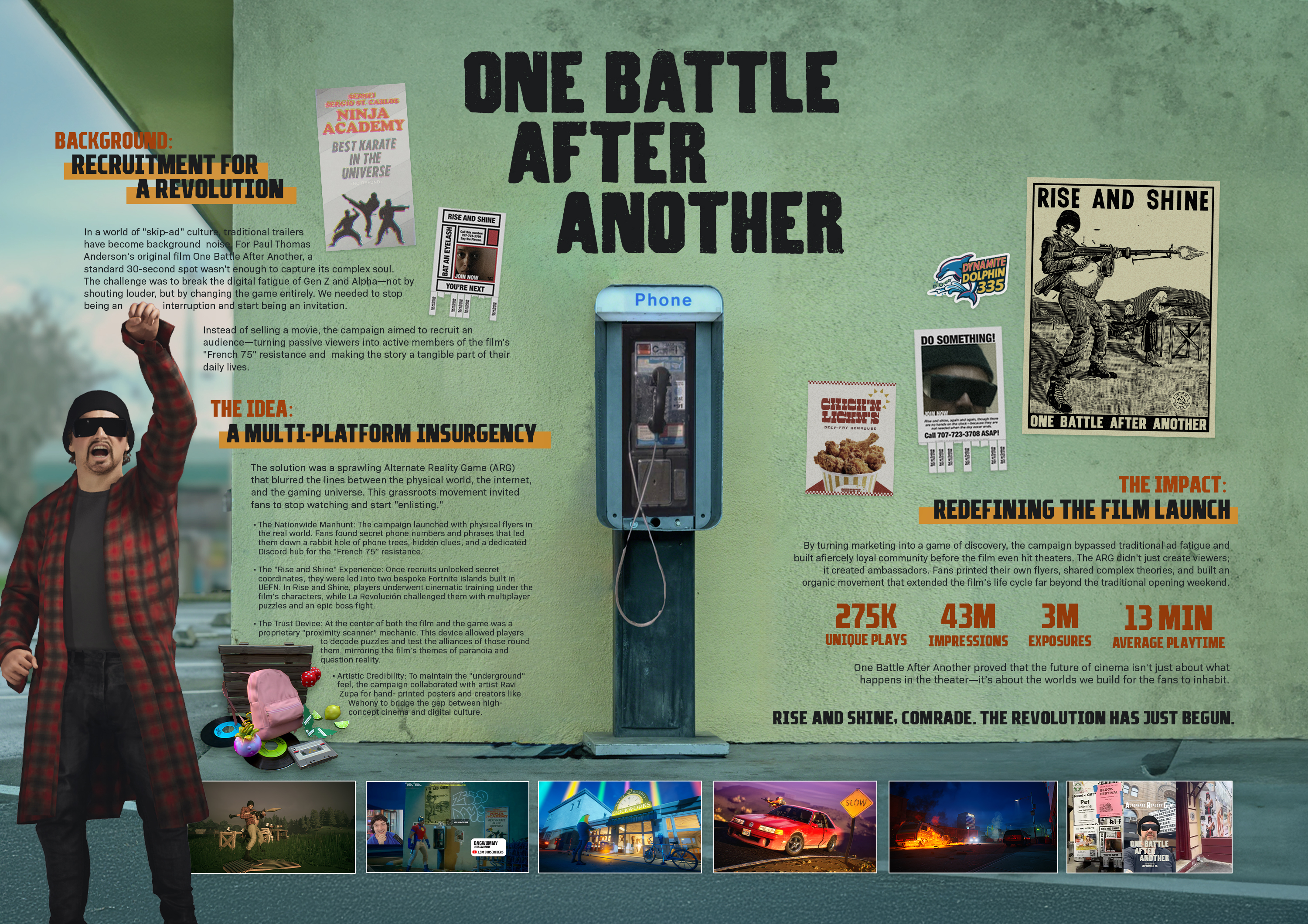
The core idea behind the campaign was to transform a passive film launch into an active "insurgency." Recognizing that Gen Z and Gen Alpha possess a deep-seated "skip-ad" culture, the strategy moved away from traditional 30-second trailers to create a sprawling Alternate Reality Game (ARG). By blurring the lines between the physical world and the digital universe, we didn't just market a movie; we recruited a resistance.
Strategic Goals
Ultimately, the goal was to create a fiercely loyal community and an organic movement that would sustain the film’s lifecycle far beyond its opening weekend, turning the audience into the film's most powerful ambassadors.
To bring One Battle After Another to life, we executed a multi-platform "insurgency" that prioritized mystery over traditional promotion. Our plan of action was built on a breadcrumb trail designed to reward curiosity rather than force attention.
The Execution: A Three-Tiered Rollout
Key Features & Innovation
The centerpiece of our unique approach was the "Trust Device." This proprietary proximity scanner mechanic was integrated into both the ARG and the Fortnite gameplay. It forced players to scan those around them to decode puzzles and verify alliances—directly mirroring the film's core themes of paranoia and questioned reality. By making the film’s subtext a gameplay mechanic, we ensured the marketing felt like an extension of Paul Thomas Anderson’s creative vision.
Overcoming Challenges
The primary challenge was maintaining artistic credibility while operating within a massive platform like Fortnite. Gen Z is incredibly sensitive to "corporate cringe." To overcome this, we:
Why It’s Unique
This project redefined the film launch by proving that a movie's life cycle doesn't start at the theater—it starts in the inhabited worlds of the fans. We didn't just tell a story; we built a sandbox for it. By the time the film hit theaters, we hadn't just built an audience—we had mobilized an army of ambassadors who were already deeply invested in the lore because they had lived it.
The results confirmed that our "recruitment" strategy successfully pierced the digital fatigue of a cynical audience. By shifting the metric from passive reach to active participation, we achieved a level of brand intimacy that traditional trailers cannot replicate.
Quantifiable Success
Why It Worked
We consider this a success because we honored the artistic credibility of Paul Thomas Anderson’s work while speaking the native language of Gen Z and Alpha. By integrating the "Trust Device" mechanic, we ensured that the marketing wasn't just about the movie—it was the movie. We didn't just buy ad space; we earned cultural real estate. As noted by /Film, we turned movie marketing into gameplay, proving that the future of cinema lies in the inhabited worlds we build for fans.