Zoom is universally known, but narrowly understood. While millions rely on Zoom every day, the brand is still culturally anchored to a single behavior: meetings, masking its evolution into an AI-first workplace platform built to help people regain flow, focus, and control at work.
The objective of Zoom Ahead was to reposition Zoom as a platform for people who make things happen by launching a movement rooted in empowering the every day worker. It’s a rallying cry against workplace absurdity, bureaucracy, and over-scheduled days. The campaign set out to turn everyday users into advocates, restore cultural relevance, and show that Zoom isn’t just a tool you use, but a platform that helps people make progress at work.
Rather than leading with features or enterprise messaging, Zoom Ahead aimed to spark a movement: one rooted in recognition. We wanted people to see their daily frustrations reflected, feel understood, and rediscover Zoom as the technology that brings flow, momentum, and human connection back into work.
Our goals were to:
The campaign’s ambition went beyond awareness: it aimed to create a movement that combined emotional resonance with commercial impact.
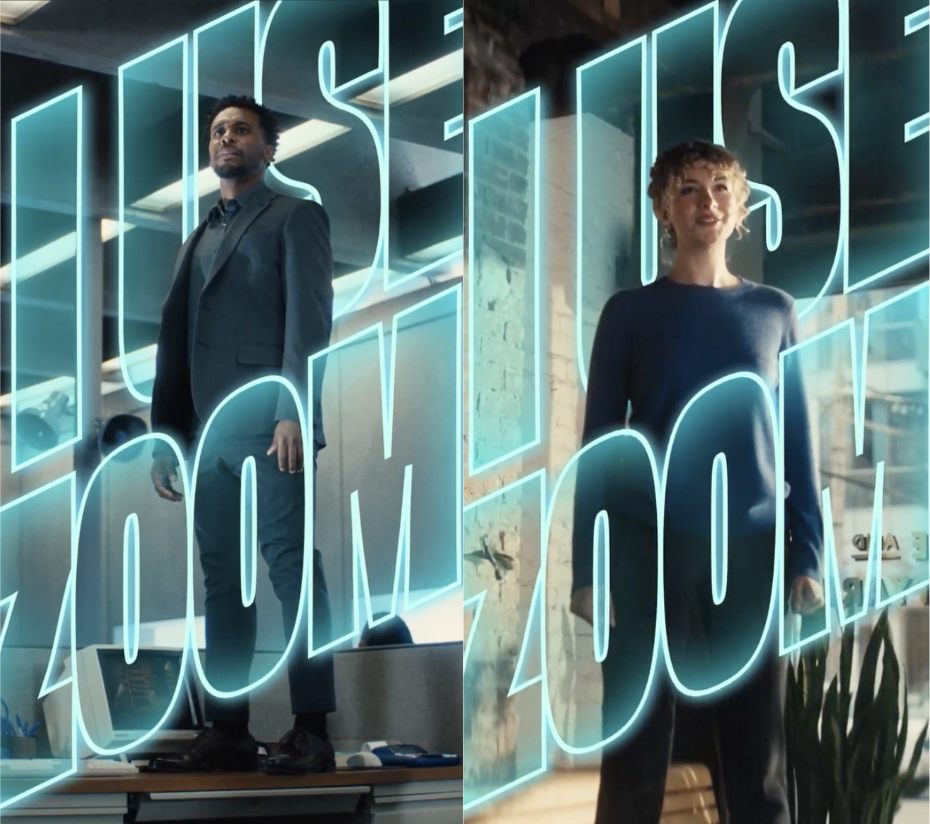
Zoom Ahead launched as a multi-phase, fully integrated campaign designed to feel less like a campaign and more like a cultural movement, meeting audiences wherever conversations about work were happening. Anchored by a breakthrough TV spot featuring Bowen Yang, the campaign used humor to capture the frustrations of modern work—endless meetings, constant notifications, and fragmented tools—while positioning Zoom as the antidote: a platform that enables people to work with clarity, confidence, and momentum.
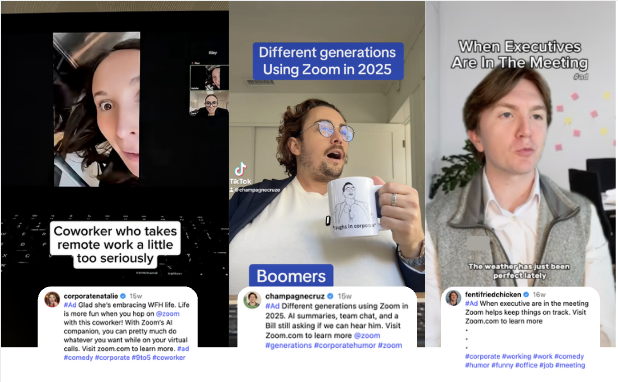
The campaign pre-launched with people, not brand claims. Zoom partnered with social creators, like Corporate Natalie and Deshauna Barber, and podcast hosts, including Pivot with Kara Swisher and Scott Galloway and Decoder with Nilay Patel, already shaping conversations about productivity, hybrid work, and modern work culture. Instead of scripted endorsements, these voices shared lived experiences—frustrations with how work feels today and why Zoom helps them move forward. By turning everyday usage into cultural proof, the repositioning felt earned, not advertised.
High-impact TV and CTV placements anchored the launch, debuting the campaign during premium cultural moments including the College Football Playoffs, NFL Championships, Golden Globes, and top streaming environments. These moments reintroduced Zoom to mass audiences with confidence and humor, signaling a bold new chapter beyond meetings. Digital media extended reach and frequency across paid social, radio, and display, while a flexible creative system ensured cohesion across every format.
Brand storytelling and demand execution launched in parallel. Paid social, SEM, content syndication, and display activated persona-led messaging for IT Decision Makers, CM Decision Makers, and Small Business Owners—allowing Zoom to directly observe how brand momentum translated into consideration, engagement, and pipeline activity. This integration transformed marketing into a diagnostic growth function, revealing where brand investment improved demand efficiency and where spend could be optimized.
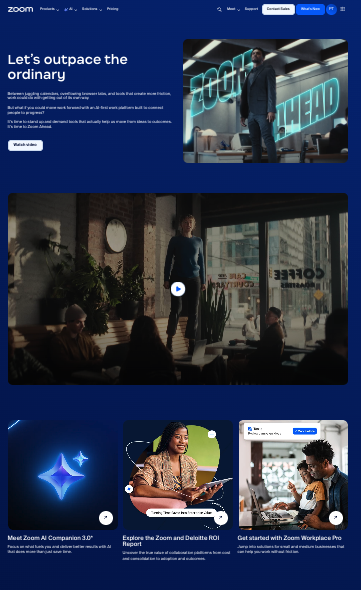
ZoomAhead.com served as the campaign’s connective tissue, housing the hero film, manifesto, and product storytelling in one place. The experience preserved emotional momentum while naturally guiding audiences to discover the broader Zoom platform.
Zoom’s biggest challenge was to break through entrenched perceptions of Zoom as “just meetings” and resonating across diverse B2B audiences—from enterprise buyers to SMB decision-makers. The team overcame this by leveraging humor, cultural fluency, and relatability, highlighting AI capabilities, collaboration tools, and CX innovations while maintaining a people-first tone.
By leading with real people, cultural humor, and universally recognizable work moments, Zoom Ahead made a complex repositioning feel intuitive, human, and overdue—while creating a system designed to learn, optimize, and scale. At its heart, the campaign spoke to a universal truth: modern work has become exhausting, but with Zoom, people can move forward with clarity, confidence, and momentum.
Despite only having launched in late December, Zoom Ahead delivered immediate, measurable impact at scale, proving the brand was breaking through, buyers were responding, and growth was becoming more efficient. The campaign generated over 311MM impressions to date, surpassing the goal by 55%, and an earned media value of $1.3MM, surpassing full-year campaign benchmarks and validating both the creative ambition and integrated strategy. LinkedIn ‘share of feed’ increased by 316%, and social followership grew by 17.8K, signaling increased visibility and cultural relevance.
Repositioning Zoom as a Platform
Among U.S. end users, the campaign generated a +10-point lift in “more than meetings” perception, exceeding the full-campaign goal by more than 4x. Enterprise ITDMs saw a +15.1-point lift in consideration, signaling strong resonance with decision-makers early in the campaign lifecycle.
The campaign reinforced Zoom’s product awareness and perception across audiences, including +9.0-point lift in favorability among Microsoft users and +16.9-point lift on “unifies meetings, chat, docs, and more” among enterprise buyers
Business Momentum
As brand visibility and perception shifted, demand performance became meaningfully more efficient. Website traffic grew 19% year-over-year during the campaign window, 28% increase in ‘Contact Sales’ requests, 65% decrease in CPL on LinkedIn, and 1.8x ROAS across Demand campaigns on LinkedIn, translating awareness into active consideration and pipeline acceleration.
Together, these results confirmed Zoom Ahead’s success as both a brand platform and a diagnostic growth engine, allowing Zoom to scale deliberately, while transforming Zoom to the AI-first work platform for the people.