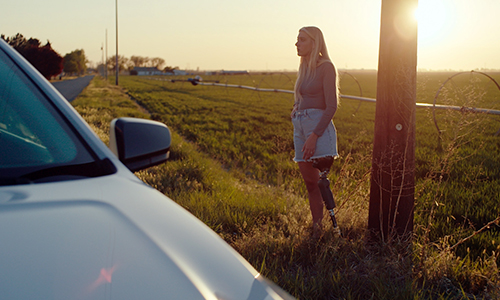
Teen drivers are disproportionately affected by preventable crashes, yet traditional safety messages rarely break through. This campaign set out to change that by shifting teen attitudes toward safe driving and prompting meaningful conversations at home.
The primary audience was teen drivers, with parents as a critical secondary audience. Research revealed that teens respond to stories they can see themselves in, while parents play a decisive role in reinforcing safe driving expectations at home. Our goal was twofold: to encourage teens to take safe driving seriously and to empower parents to initiate conversations with their teens about the real-world consequences of unsafe driving.
At the center of the campaign was a testimonial-driven PSA featuring Kennedy, whose first-hand account brought the stakes of unsafe driving to life. Her voice resonated with teens not as a lecture, but as a lived experience. For parents, her story served as a powerful opening to start a conversation many struggle to initiate. Supporting teaser content was designed to reach both audiences simultaneously—meeting teens in their digital space while signaling to parents that their involvement matters.
This work directly supports NHTSA’s mission to save lives, prevent injuries, and reduce economic costs from road traffic crashes, with a particular emphasis on teen driving safety. Success was defined by the campaign’s ability to engage both audiences organically, spark conversation, and reinforce safe driving as a shared responsibility between teens and parents.
The strategy for this campaign was rooted in extensive consumer and market research to understand how both teens and parents engage with teen driving safety messages. Findings revealed that fear-based or instructional messaging often leads to disengagement, while real, personal stories delivered by relatable peers drive stronger emotional connection and message retention.
Concept testing further validated that a testimonial format was the most effective approach, outperforming other creative concepts by resonating as authentic, credible, and non-preachy. Based on these insights, we centered the campaign around a first-person testimonial featuring Kennedy, whose lived experience allowed the message to feel genuine rather than institutional.
The creative approach intentionally balanced two audiences. For teens, Kennedy was positioned as a peer—someone who spoke their language and reflected their reality. For parents, her story served as a conversation starter, reinforcing the importance of discussing safe driving before tragedy strikes. Short teaser videos were developed to complement the full PSA, tailored to organically reach both teens and parents across social platforms.
Production was a collaborative effort between NHTSA (client), Stratacomm (agency), and production partner Spang. Together, the teams prioritized authenticity over polish, ensuring the final product felt real, emotionally grounded, and trustworthy. Every creative decision—from pacing to tone—was informed by research findings and tested insights.
The campaign was distributed organically through social media channels and shared with partners across the traffic safety community, relying entirely on earned and partner-driven amplification rather than paid media. In a category where teens quickly dismiss institutional messaging, this approach reinforced credibility and allowed the content to spread in environments where trust already existed.
One of the primary challenges was addressing a sensitive topic without alienating teens or overwhelming parents. By grounding the work in research, choosing a testimonial format, and carefully balancing emotional impact with approachability, the campaign successfully navigated this challenge. The result was a PSA that stands apart from traditional safety messaging by fostering empathy, dialogue, and shared responsibility.
The campaign met its objectives by delivering a teen driving safety message that resonated with both teens and parents, validating the effectiveness of a research-driven, testimonial-based approach. Organic distribution and partner sharing allowed the PSA and supporting teasers to reach audiences in trusted spaces, reinforcing credibility and emotional impact without paid promotion. The video received over 10,000 organic views in its first four months on NHTSA’s owned channels, reflecting sustained, voluntary engagement.
Audience response reflected strong engagement and receptivity, particularly to the authenticity of Kennedy’s story. The content succeeded in reframing safe driving not as a lecture, but as a personal and shared responsibility—encouraging teens to take driving decisions seriously and prompting parents to initiate meaningful conversations with their children. The success of this campaign reinforces a key insight: when teens hear from someone who looks and sounds like them, the message doesn’t feel like a warning — it feels like a reality.
The use of research to guide creative decisions proved critical to the campaign’s success. By aligning format, tone, and distribution with tested insights, the campaign delivered a message that cut through traditional safety noise and connected on a human level.
Beyond immediate engagement, the PSA has become a reusable asset within the broader teen driving safety ecosystem, shared by partners and stakeholders committed to reducing teen crash fatalities. The campaign demonstrates how thoughtful, insight-led storytelling can drive awareness, conversation, and cultural change around critical public safety issues.