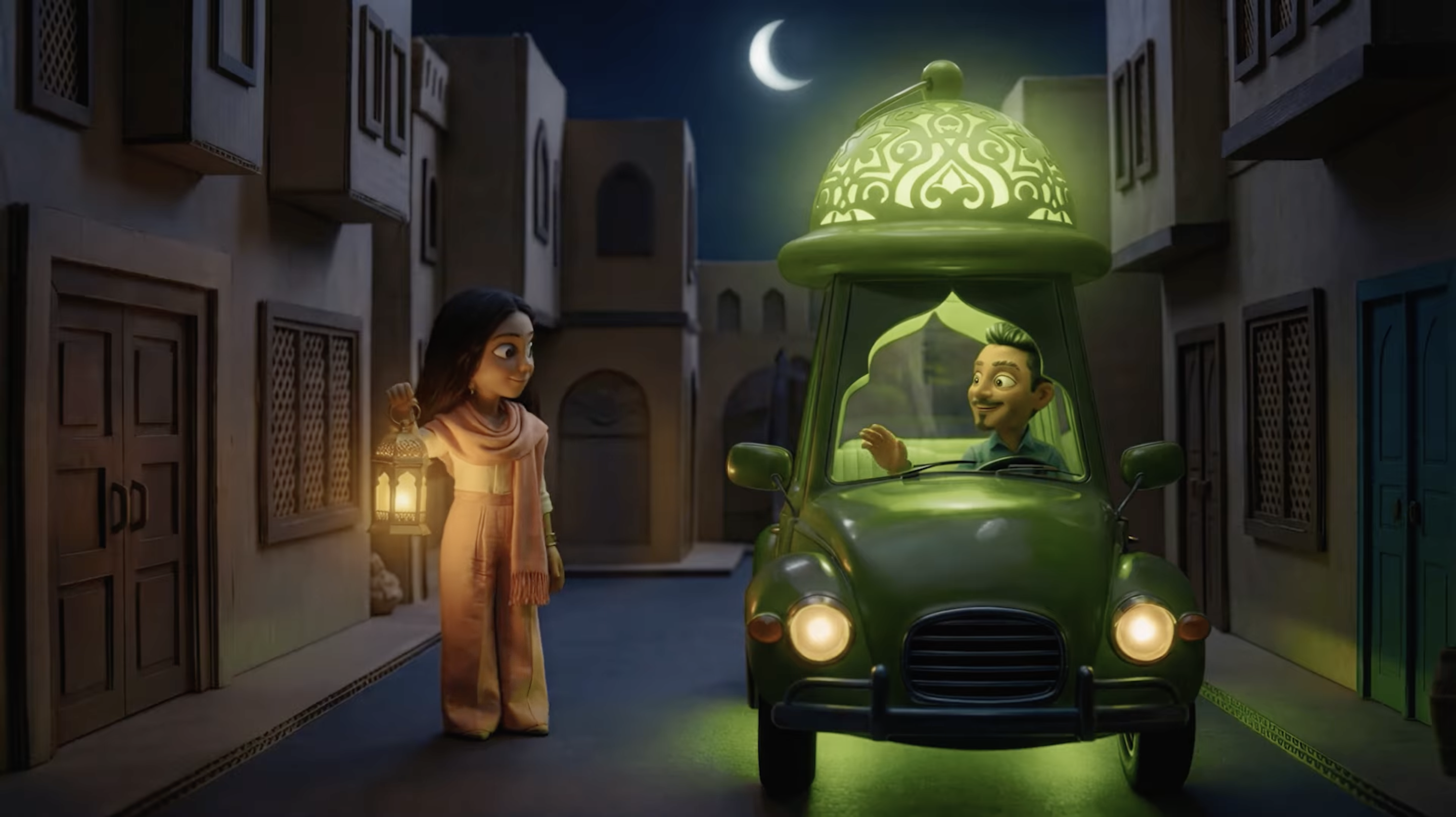
“Wahawy Ya Wahawy” was created to show that a brand can enter Ramadan culture not by interrupting tradition, but by understanding it, respecting it and giving it a new emotional meaning.
In Egypt, Ramadan is one of the most culturally significant moments of the year. It is a season of family, memory, music, movement and shared rituals. For many Egyptians, “Wahawy Ya Wahawy” is more than a song — it is a nostalgic sound of Ramadan itself. inDrive wanted to use this familiar cultural memory to tell a modern story about choice.
The idea was to connect the spirit of Ramadan with inDrive’s product truth: people should not be controlled by fixed conditions, but empowered to choose their own path. In the app, this means passengers and drivers can agree on the price and decide what feels fair. In the campaign, it became a story about freedom, movement and choice told through a Ramadan world people instantly recognized.
The campaign set out to achieve three connected goals: create locally resonant branded content for Egypt during Ramadan; refresh a beloved cultural tradition through a distinctive and memorable visual world; and strengthen inDrive’s emotional role by showing that choice can be part of everyday life, even during the most traditional moments.
Ramadan celebrates tradition. inDrive celebrates choice. The objective was to make them speak the same language — and prove that branded content rooted in local culture could drive both emotional connection and business impact.
The strategy behind “Wahawy Ya Wahawy” was to enter Ramadan through a memory Egyptians already loved, then give it a new meaning connected to choice.
Instead of creating a generic seasonal message, inDrive built the campaign around one of Egypt’s most recognizable Ramadan references: “Wahawy Ya Wahawy.” The song carries instant nostalgia, but the challenge was to refresh it without losing its emotional and cultural value. To keep the work rooted in feeling, not only craft, the campaign reimagined the song through a performance by Donia Wael, connecting a beloved Ramadan memory to a new story about choice.
The creative answer was a magical Ramadan world built around the Fanous Car and puppet characters. At first, the puppets appeared to belong to a traditional performance world: beautiful, crafted, nostalgic, and controlled by strings. But then they did something unexpected. They broke their strings.
This became the campaign’s metaphor. People should not be controlled by fixed conditions, but empowered to choose their own path. In a Ramadan story, the puppets’ freedom became a symbol of movement and self-determination. In inDrive’s product, that same idea lives in the ability for passengers and drivers to agree on the price and choose what feels fair.
Generative AI played a key role in bringing this visual world to life. It helped create the campaign’s distinctive puppet universe, visual textures and magical Ramadan atmosphere. But AI was used as a craft tool, not as a replacement for human creativity. The process remained guided by human art direction, cultural judgment, editing, post-production and brand storytelling, ensuring that the final work felt emotionally Egyptian rather than artificially generated.
The campaign was executed as an integrated local ecosystem. The hero branded content carried the main story and visual world. Digital and social assets adapted the idea into shorter, more shareable moments. Influencer content helped the campaign enter everyday Ramadan conversation. PR explained the creative and technological craft behind the work. Radio and CRM helped reinforce the seasonal message, while in-app and landing page touchpoints connected the story back to the product experience.
The biggest challenge was balance. Ramadan is deeply emotional and culturally sensitive, while AI can easily feel cold or gimmicky if used without purpose. To overcome this, the team made technology serve tradition, not compete with it. Every creative choice was built around a familiar cultural memory, a warm visual language and a clear human message about freedom of choice.
What made “Wahawy Ya Wahawy” unique was this combination: a beloved Egyptian Ramadan tradition, a modern AI-assisted craft approach, and a product truth expressed through a simple emotional metaphor. Ramadan celebrates tradition. inDrive celebrates choice. The campaign made them speak the same language.
“Wahawy Ya Wahawy” succeeded because it turned a beloved Ramadan memory into content people watched, remembered, responded to and acted on.
The campaign reached 13.3 million people and generated 9.5 million YouTube views, almost doubling the 5 million target. It also delivered strong media efficiency, with 6.3 million impressions versus a 4.5 million target and CPV of $0.001 versus a $0.01 target. But the result was not only reach. Audiences stayed with the story: average view time reached 31 seconds on a 60-second film, showing that people watched long enough to experience the music, visual craft and message of choice.
The campaign also created measurable brand impact. Meta ad recall reached 15.7%, more than twice the benchmark range of 5.2–6.9%. inDrive also surpassed Uber for the first time in top-of-mind awareness, reaching 42% versus Uber’s 39%.
Audience response showed the same positive shift. Positive comments grew by 26%, peaking at 59%. Instagram NSS improved from 42.86% to 84.70%, while TikTok NSS moved from -31.71% to 32.52%.
Most importantly, the campaign translated cultural relevance into real business and community impact. Versus operational targets, MAU grew by 15%, new users by 23%, orders by 11% and rides by 19%. The campaign also generated EGP 5 million donated to MEF and supported 5,000 children.
For us, success was proving that local branded content, powered by meaningful AI craft, could drive attention, affection, action and real-world impact.