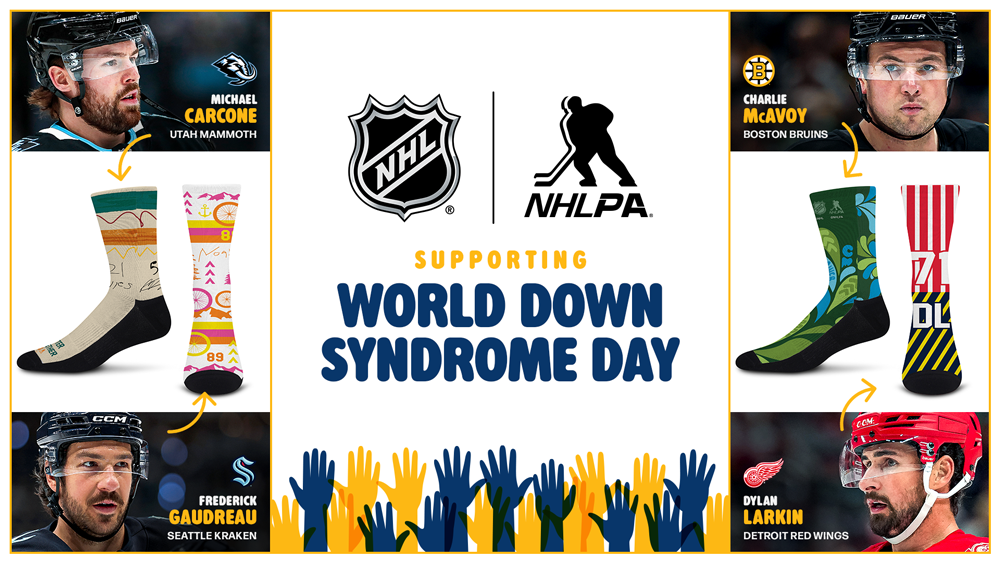
On World Down Syndrome Day, celebrated each year on March 21, it is customary to wear mismatched socks to celebrate acceptance of differences. The National Hockey League recognized an opportunity to engage with this tradition by inviting NHL players who have personal connections to the Down syndrome community to design unique pairs of mismatched socks, shining a spotlight on Down syndrome awareness.
Manufactured by For Bare Feet, the socks were made available for purchase, and fans were encouraged to wear mismatched socks on and around March 21. As part of the project, the NHL and the NHLPA contributed a collective donation of $15,000 to the American Special Hockey Association (ASHA) to further the organization’s mission to grow special hockey.
The mismatched sock project aimed to leverage the global reach of the National Hockey League, the National Hockey League Players’ Association, and League Clubs and players to raise awareness and foster inclusion for people with Down syndrome. Players with personal ties to the cause — Michael Carcone (Utah Mammoth), Frederick Gaudreau (Seattle Kraken), Dylan Larkin (Detroit Red Wings) and Charlie McAvoy (Boston Bruins) — designed socks that reflected their connection to and appreciation for the initiative. A strategic priority was to make the cause feel personal, deepening fans’ understanding of its importance.
It was also important to promote sock sales so fans had a tangible way to participate in the World Down Syndrome Day tradition. Finally, the project aimed to link awareness with impact, which is what informed the ASHA donation.
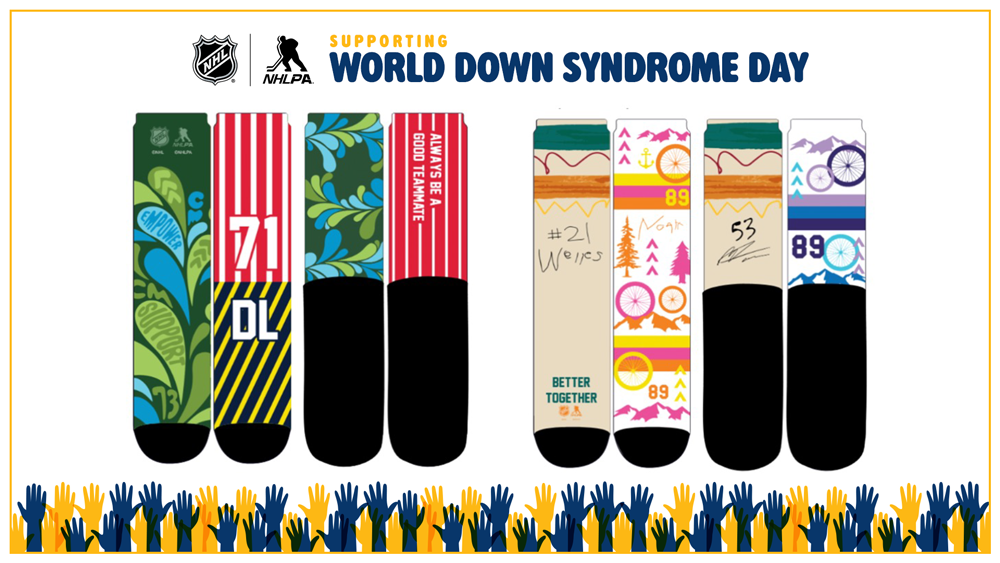
To bring the project to life, the NHL created an opportunity for players to share design ideas with artists from For Bare Feet. Each of the four players was asked to design one sock, ultimately creating two pairs of mismatched socks: Carcone-Gaudreau (Pair 1) and McAvoy-Larkin (Pair 2).
Design concepts were mindful of mixing personal details with symbols that have specific meaning in the community, as well as messages that would promote general awareness. For example, Carcone’s sock incorporated the signature of his friend and neighbor, Welles, who has Down syndrome; Gaudreau and McAvoy’s socks included the “three arrows” symbol, which represents the three copies of the twenty-first chromosome in the Down syndrome community; and Larkin’s sock incorporated the message “always be a good teammate” as an example for all fans.
Once designs were finalized, the NHL created a multi-layered content plan to inform and engage fans.
Following the press release announcement, the NHL launched a social media campaign featuring graphics that highlighted each player’s design, shared personal quotes about their inspiration for participating, and provided fans with information on how to purchase the items through NHL Shop. In addition, the NHL provided socks to broadcast partners to be worn on-air around March 21 to maximize visibility.
At the Club level, the NHL provided socks for the four players to share with their teammates. Reflecting the partnership at the heart of this campaign, players rallied their teammates to wear the socks during walk-ins on gameday. As a result, the Mammoth, Kraken, Red Wings, and Bruins were able to capture content featuring players taking part in the mismatched sock tradition, helping explain the meaning of World Down Syndrome Day, while resharing links for fans to purchase their own pairs.
Player-specific content was packaged for social media as well as longer-form content (e.g., for Regional Broadcast Networks and YouTube) that delved into players’ connections to the cause – for example, Gaudreau’s relationship with his nephew, Noah, and McAvoy’s relationship with a TD Garden employee, Johnny, both of whom have Down syndrome. The Red Wings hosted the Bruins on ABC primetime on Saturday, March 21, creating the perfect opportunity to highlight Larkin and McAvoy’s involvement both during the broadcast and in-game on the jumbotron.
The challenge of aligning the stakeholders involved in this project – NHL players, four NHL Clubs, an NHL licensee, and NHL rightsholders – was also the source of the project’s power.
Players, in particular, often manage demanding schedules, which made the design phase longer than expected. To keep the project on track, the NHL worked closely with For Bare Feet to confirm the production timeline and used the pre-launch period to refine a content strategy. That strategy helped fans understand the mismatched sock tradition, connect with the players’ involvement, and ultimately purchase pairs.
The NHL and NHLPA also chose to guarantee a grant of $15,000 in association with the project prior to launch.
Meeting the NHL’s goal of promoting inclusion, content related to this campaign generated more than 4.2 million views across social media -- building awareness for the Down syndrome community. It reached further audiences through national broadcasts like ESPN and TNT, plus news outlets like The Boston Globe. Players’ platforms drove significant attention, as Carcone, Gaudreau, Larkin, and McAvoy featured prominently in storytelling across their respective team markets.
Fan participation was another sign of success: From campaign launch on March 18, NHL Shop experienced a 482% increase in sales in the sock category compared to the same timeframe a week prior with NHL Shop selling out its inventory on March 25. The NHL’s content strategy was critical, as nearly 50% percent of sales for the mismatched socks were driven by links from NHL social media and NHL.com.
Another major milestone came when the Hockey Hall of Fame added the collection to a special display, helping extend awareness to the thousands of visitors who pass through its doors each week.
This campaign’s impact lies not only in the $15,000 grant to ASHA, which will improve access to ice time and equipment for special hockey athletes, but also in the conversations sparked by fans wearing mismatched socks. To celebrate the campaign, the NHL donated 80 pairs to youth hockey players who attended the Detroit - Boston game on March 21. Throughout the hockey community, the socks educate and inspire and continue to serve as a tangible representation of empowering people with Down syndrome.