The objective of this campaign was to encourage audiences to reflect on the growing gap between the lives we genuinely experience and the lives we often curate for social media. Through a series of relatable visual stories, the project explores how the pursuit of validation, attention, and the appearance of a perfect life can sometimes come at the expense of authentic experiences, meaningful relationships, and presence in the real world.
The campaign highlights a modern paradox: while social media allows us to share our lives with more people than ever before, it can also create pressure to perform, impress, and seek approval rather than fully live in the moments we are experiencing. By contrasting carefully crafted online appearances with the reality behind them, the project aims to spark conversations about authenticity, digital well-being, and the importance of prioritizing genuine human connection over the pursuit of online validation.
Ultimately, our goal was to inspire viewers to spend less time performing life for an audience and more time truly living it.
This project was inspired by a simple yet increasingly common observation: we live in a time where people appear more connected than ever through social media, while often becoming more disconnected from the real experiences and relationships around them. We wanted to tell that story in a visual, emotional, and relatable way that anyone could recognize.
We developed the concept and narrative entirely in-house, creating a series of everyday scenarios that highlighted the contrast between the lives people present online and the reality they experience offline. Each scene was carefully planned to represent a different form of disconnection.
In the opening sequence, we created the image of a seemingly successful and busy couple. We carefully selected wardrobe, props, and visual elements to reinforce the appearance of a perfect life on social media. We even incorporated flowers and gifts to represent moments that seem spontaneous and meaningful in a post, but in reality can be part of a carefully curated image designed for a digital audience.
The second sequence focuses on the pressure to maintain an idealized online persona. Through styling, wardrobe choices, and visual composition, we portrayed how a seemingly flawless image can conceal a constant search for validation, approval, and engagement from others online.
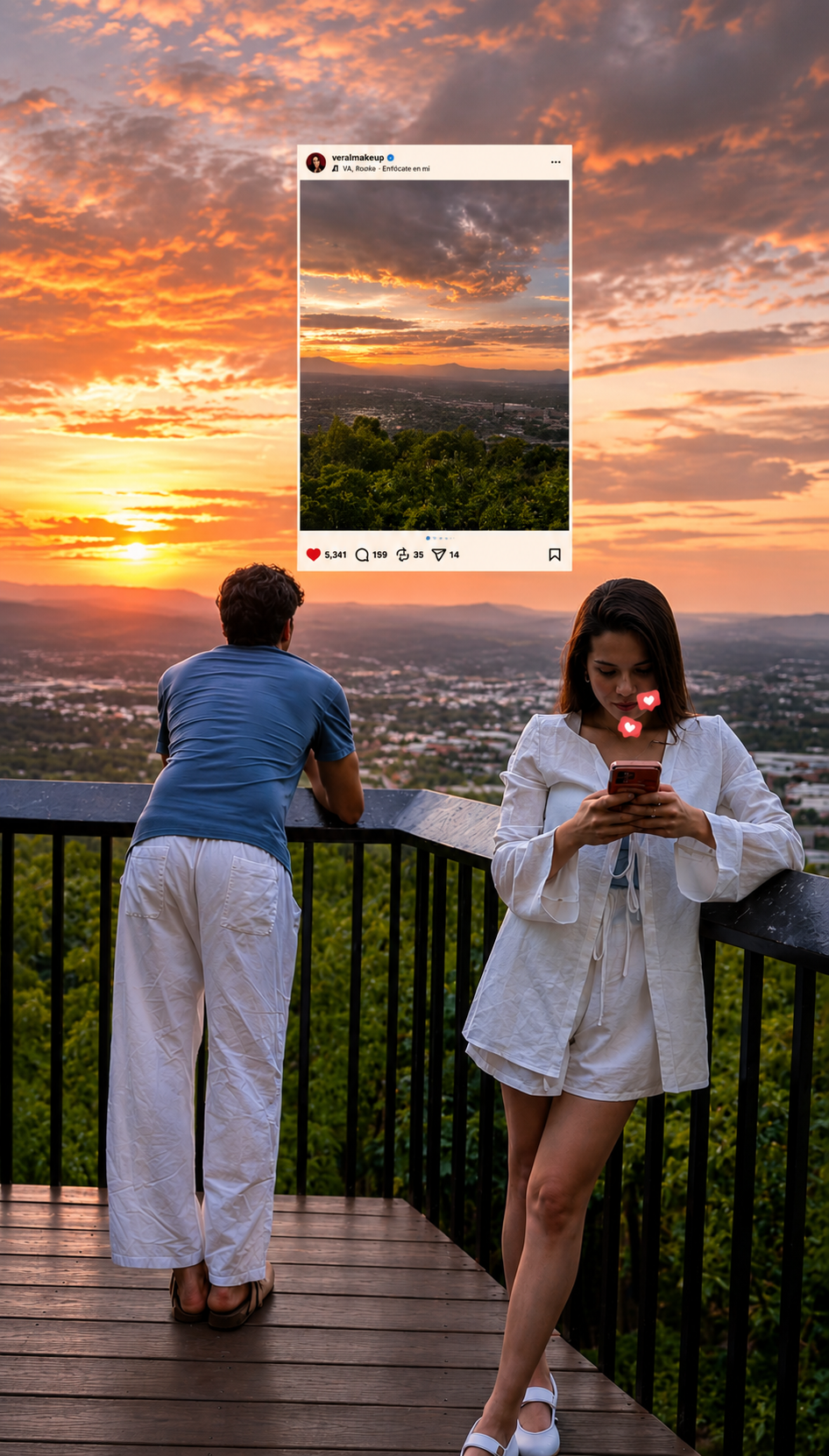
For the final scene, we traveled approximately 45 minutes to one of the most scenic overlooks in Roanoke, Virginia. We transported our camera, lighting equipment, and wardrobe changes to capture the project’s central contrast: while one person is fully present and enjoying the breathtaking view, the other remains focused on creating content, checking notifications, and seeking digital attention. This moment serves as the visual climax of the story, illustrating the difference between truly experiencing a moment and simply documenting it for others.
What makes this project unique is its ability to address complex themes such as social validation, authenticity, and digital well-being through simple, relatable, and universally recognizable situations. Rather than criticizing social media itself, the project encourages reflection and invites viewers to question how much of their lives are being lived for themselves versus for an audience online
The project exceeded our expectations both in reach and audience engagement. To date, the video has generated more than 11.2 million views on Instagram, along with over 749,000 likes, 18,000 reposts, and more than 8,700 shares. These results allowed the message to reach a broad and diverse audience far beyond our existing community.
More importantly than the performance metrics, the audience response demonstrated that the message resonated deeply with viewers. The content sparked conversations around authenticity, social media pressure, digital well-being, and the growing gap between online appearances and real-life experiences. Many viewers expressed how strongly they related to the story and reflected on the pressure to present an idealized version of life online.
We consider this project a success because it achieved exactly what it was designed to do: encourage reflection. Through visual storytelling rather than direct instruction, the video invited audiences to question how much of their lives are being lived for themselves versus for an online audience. The strong organic reach and high level of engagement showed that the themes of authenticity, presence, and genuine human connection resonate with people across different backgrounds and experiences.
Ultimately, the success of this project is not measured solely by its 11.2 million views, but by its ability to start meaningful conversations about authenticity in the digital age and inspire viewers to value real experiences and relationships over the pursuit of online validation.