Canuck Place Children's Hospice provides paediatric palliative care at no cost to families across British Columbia. Light a Life is its giving campaign, which ran 15 October to 31 December 2025, honouring children with life-threatening illnesses and the families who love them, and funding the promise that care stays free.
Canuck Place set a paid media revenue goal of $300,000 CAD for its full 2025/26 fiscal year, April 2025 through March 2026. Light a Life was the largest opportunity in that year to move it, and paid media had to shift an annual number inside one campaign window.
The commercial objective was clear. The strategic problem was cost. Light a Life closes across the most contested weeks in the Canadian media calendar, when every retailer, children's charity and cause campaign competes for the same inventory. A provincial hospice cannot outbid national advertisers, so efficiency was the only available route to growth.
Two things had to happen at once. The campaign needed to reach across a province of 5.6 million people, most of whom had never heard of Canuck Place. And it had to do that efficiently enough that a larger share of every dollar raised reached care rather than media.
We didn't judge Light a Life's channels by direct conversions alone. Every placement was given a role, and judged on the job it did for the channels downstream.
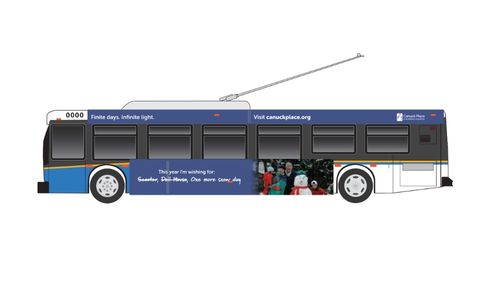
Awareness ran offline first. A Greater Vancouver out-of-home buy with Pattison anchored it: Digital Urban Pathway, Street Level Digital, Superboards, Transit and King Bus wraps. The digital panels ran the full campaign, the bus wraps 56 days inside it, and Pattison delivered 250% of contracted campaign delivery verified in a COMMB proof-of-performance report. YouTube, CTV and Spotify carried that reach into digital, while CBC and Daily Hive native told the story in editorial form, because credibility persuades for a hospice most people have never heard of.
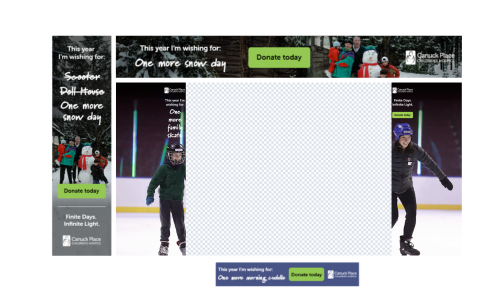
Consideration ran on Programmatic Display, Meta and Performance Max. Display and Meta were the lines that looked weakest on direct conversions. Rather than weigh them on donations closed, the team treated them as the connective tissue of the funnel, feeding warm traffic into remarketing pools that Search and Performance Max could later convert. That is what kept upper-funnel budget in place through the campaign.
Decision-stage media closed. Branded Search captured people already searching for a way to give; Meta retargeting returned to earlier engagers.
Two decisions carried real risk. The team gave Performance Max far more autonomy than in previous years, letting its bidding find and scale high-capacity donors rather than constraining it manually. With a fixed close of 31 December and no second chance at the giving peak, that meant trusting automation at the moment it mattered most.
The team also cut live. November's mid-campaign review showed YouTube and CTV underdelivering against their assigned roles. Both were paused in early December and the money moved into Performance Max, in the fortnight when giving intent peaks and a wasted week cannot be recovered.
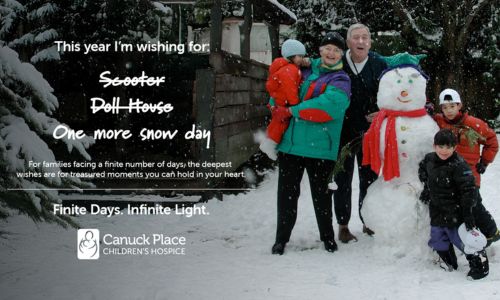
The creative gave the media something worth placing. The previous campaign, Canuck Place Is, was informational, a list of what the hospice does. Creative Director, Geoff Ravenor, replaced it with Finite Days, Infinite Light and a device taken from a child's Christmas list, toys struck out. Scooter. Doll house. One more snow day. Other children ask for presents; these ask for time.
Messaging followed the same role logic as the media. Prospecting met one line, Light a Life. Give Today. Retargeting met another, Give Them One More Wish, which only works on someone who already knows the story. Video carried the emotional weight; static did the closing, where the job was clarity and one obvious action.
The mechanism was straightforward once roles were fixed. Out-of-home built recognition at a cost no digital channel could match. Programmatic and social turned recognition into retargetable audiences. Search and Performance Max harvested them at the point of intent. Judged alone, the middle of that chain looks like waste. Judged as the supply line, it is why the closers had anyone to close.
The paid media programme contributed $153,486 in tracked digital revenue, a 15% increase year-over-year, at a 216.73% blended ROAS. Delivered in eleven weeks, that is 51% of Canuck Place's $300,000 paid media revenue goal for its entire 2025/26 fiscal year.
That fiscal year closed at $405,023 against the $300,000 goal, up 106% from $196,000.
The campaign delivered 7.39M digital impressions and 43.2M out-of-home gross circulation across a province of 5.6 million people.
Performance Max converted the audiences Display and Meta built, delivering $70,821 against $21,240 the previous year, and 138 donations, up 55%. Its cost per donation was $132, roughly half that of a donation through Non-Branded Search. Branded Search stayed the most reliable closer, at 89% of Search revenue and 27% donation growth. The early-December reallocation shows in the same place: budget taken from CTV and YouTube went into the channel producing the campaign's cheapest donations, in the weeks when giving intent peaks.
Donor behaviour shifted, not only volume. Across all channels, Light a Life drew 3,765 donors at an average gift of $245, up 32%.
What the money holds up: Canuck Place is the only provider of paediatric palliative care in British Columbia and the Yukon, reaches 67% of children in the province who meet palliative criteria, and funds over 60% of operating costs through donations. This year it cared for 1,035 children and families, 9% more than last, free of charge.