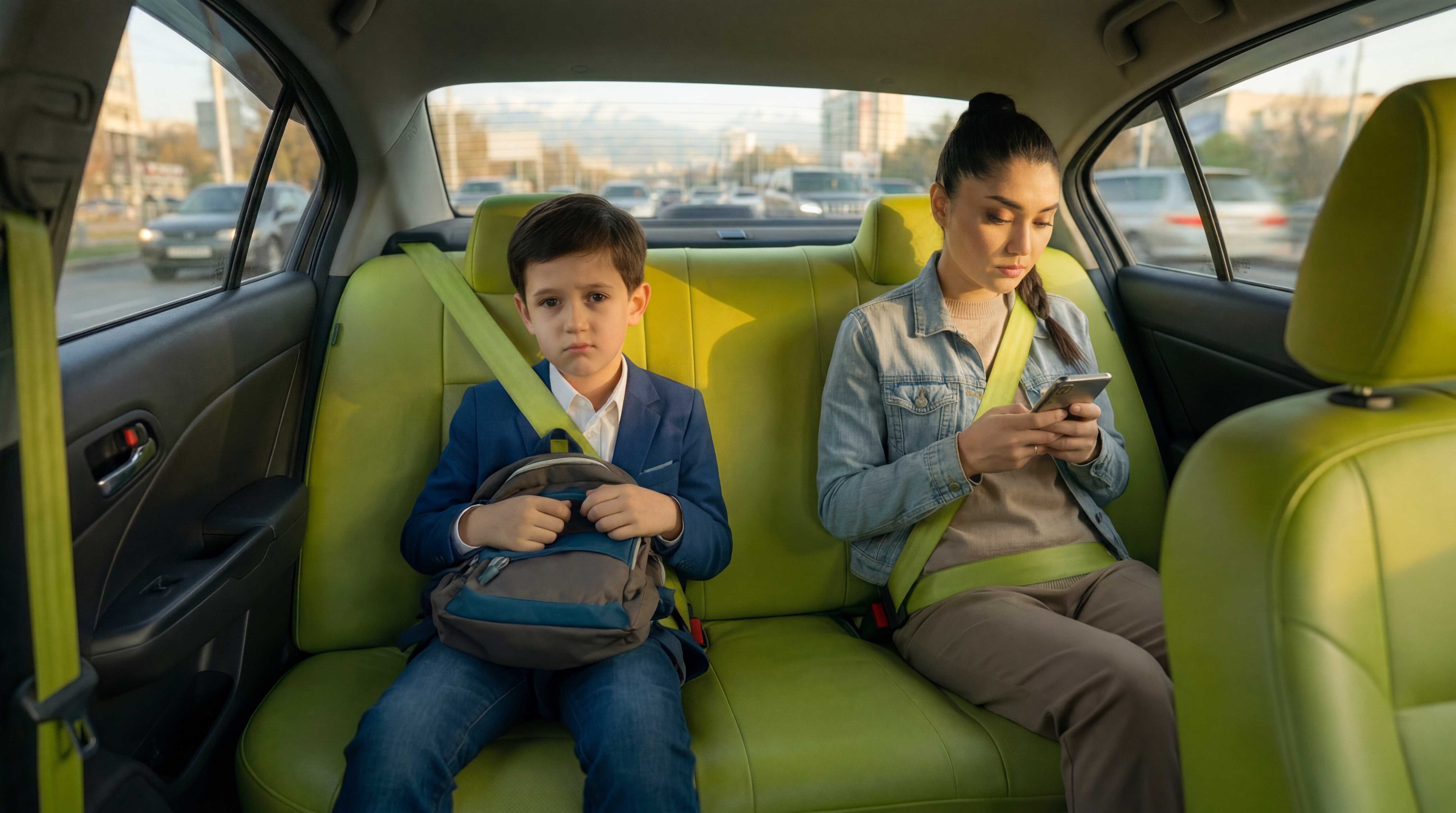
“Cancel the School Ride?” was created to turn one of the most ordinary daily routines — the ride to school — into a moment of attention, conversation and support.
In Kazakhstan, inDrive completes around 20,000 rides to schools every morning. Parents and children are often sitting side by side in the back seat, yet the ride usually passes in silence: parents scroll, check messages, and wait for the trip to end.
But for many children, school is not only a place of learning. It can also be where bullying, anxiety and fear begin. According to UNICEF, nearly 1 in 5 children in Kazakhstan have experienced bullying at school. And for parents, the hardest part is not caring — it is knowing how to ask.
The objective was to use the exact moment and space inDrive could meaningfully access — the school ride — to help parents notice early signs of distress and start difficult conversations with their children before silence becomes harm.
The campaign set out to achieve three connected goals: raise local awareness in Kazakhstan around bullying and children’s emotional wellbeing; provide parents with practical, psychologist-backed guidance inside the inDrive user journey; and create a simple product-based intervention that allowed a parent to act immediately, including changing the destination from school to a place where support could begin.
By combining in-app mechanics, the Green Back Seat installations, landing page guidance, influencer content, PR and local platform integrations, the campaign aimed to prove that a ride-hailing app could move beyond transportation — and use an everyday local journey to help families start the conversation that matters most.
The strategy began with a simple observation: the school ride is one of the few moments when a parent and child are physically close, alone, and not yet absorbed by the day ahead. For most ride-hailing brands, this is just a functional trip. For inDrive, it became a point of intervention.
The campaign was designed around the idea that parents often want to help, but do not always know how to start a conversation about bullying, fear or anxiety. The challenge was to address a sensitive mental health issue without creating panic, shame or pressure — and to do it inside a product experience people usually expect to be purely transactional.
Instead of creating a traditional awareness message, we built the campaign into the inDrive user journey itself.
When a ride to school was ordered, parents received an unexpected push notification: “Cancel the School Ride?” The message interrupted the routine at the exact moment when a parent was most likely sitting next to their child. Once inside the app, they received practical guidance developed with child psychologists: how to begin the conversation gently, which questions to ask, what not to say, and how to create space for a child to respond without pressure.
The campaign also introduced a product-based action: the option to change the destination from school to a place where support could begin. This turned the app from a mobility tool into a real-time support mechanism — giving parents not only awareness, but a possible next step.
To make the idea visible beyond the app, inDrive created the Green Back Seat. First introduced inside selected inDrive cars, it became a symbolic space for parent-child dialogue. The Green Back Seat was then extended into public installations across Almaty, reminding people that any place can become the right place to start a difficult conversation if attention is present.
The campaign ecosystem connected digital, physical and local community touchpoints: in-app banners, push notifications, a dedicated landing page, influencer content, PR, and integrations with local platforms such as Kundelik. Each channel had a clear role: the app created the intervention, the landing page offered guidance, public installations made the issue visible, and local media and platforms helped bring the conversation into Kazakhstani communities.
The biggest executional challenge was sensitivity. Bullying and children’s emotional wellbeing cannot be treated as a dramatic advertising device. The work had to feel useful, respectful and actionable. That is why the campaign avoided fearmongering and focused instead on helping parents overcome the fear of saying the wrong thing.
What made “Cancel the School Ride?” unique was not only the message, but the place where it appeared. inDrive used the one moment it truly owns — the ride itself — to turn a daily local routine into a chance to notice, talk and act.
Because “Cancel the School Ride?” was designed as a pro-social intervention, success was not defined by business conversion or ride growth. The objective was to use inDrive’s everyday product journey to help parents notice, start a conversation, and access practical guidance around bullying and children’s emotional wellbeing.
Measured against that goal, the campaign showed strong early impact.
In the first 10 days, 2,600 parents took the first step toward an important conversation with their child through the campaign experience. More than 4,000 people visited the website for guidance, showing that the issue did not only attract attention, but created active demand for support.
The campaign also generated local visibility across Kazakhstan, including coverage in Forbes Kazakhstan, ELLE Kazakhstan and Harper’s Bazaar Kazakhstan. These placements helped move the topic beyond the app and into a broader public conversation around bullying, school anxiety and the role parents can play in noticing early signs of distress.
For us, the strongest result was behavioral: parents did not simply see a message — they engaged with a tool designed to help them act in a sensitive moment. The campaign proved that a ride-hailing platform can use its real user journey for more than transportation. It can turn a routine school ride into a moment of care, attention and possible intervention.
That is why we consider the campaign a success: it transformed a local everyday behavior into measurable parent engagement and meaningful social impact.