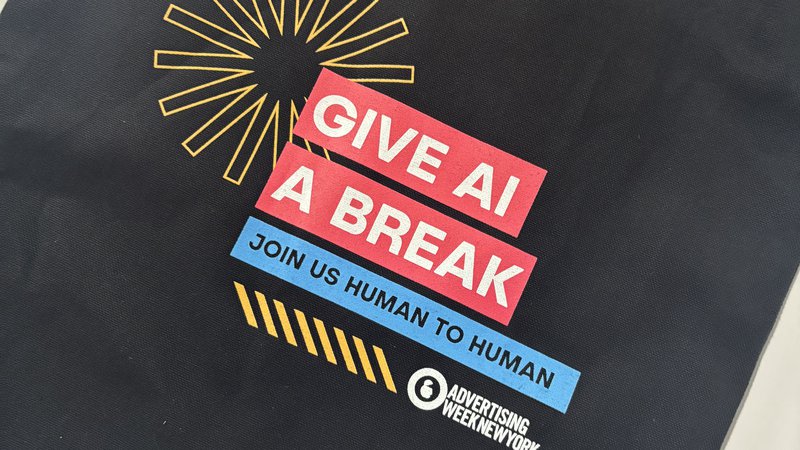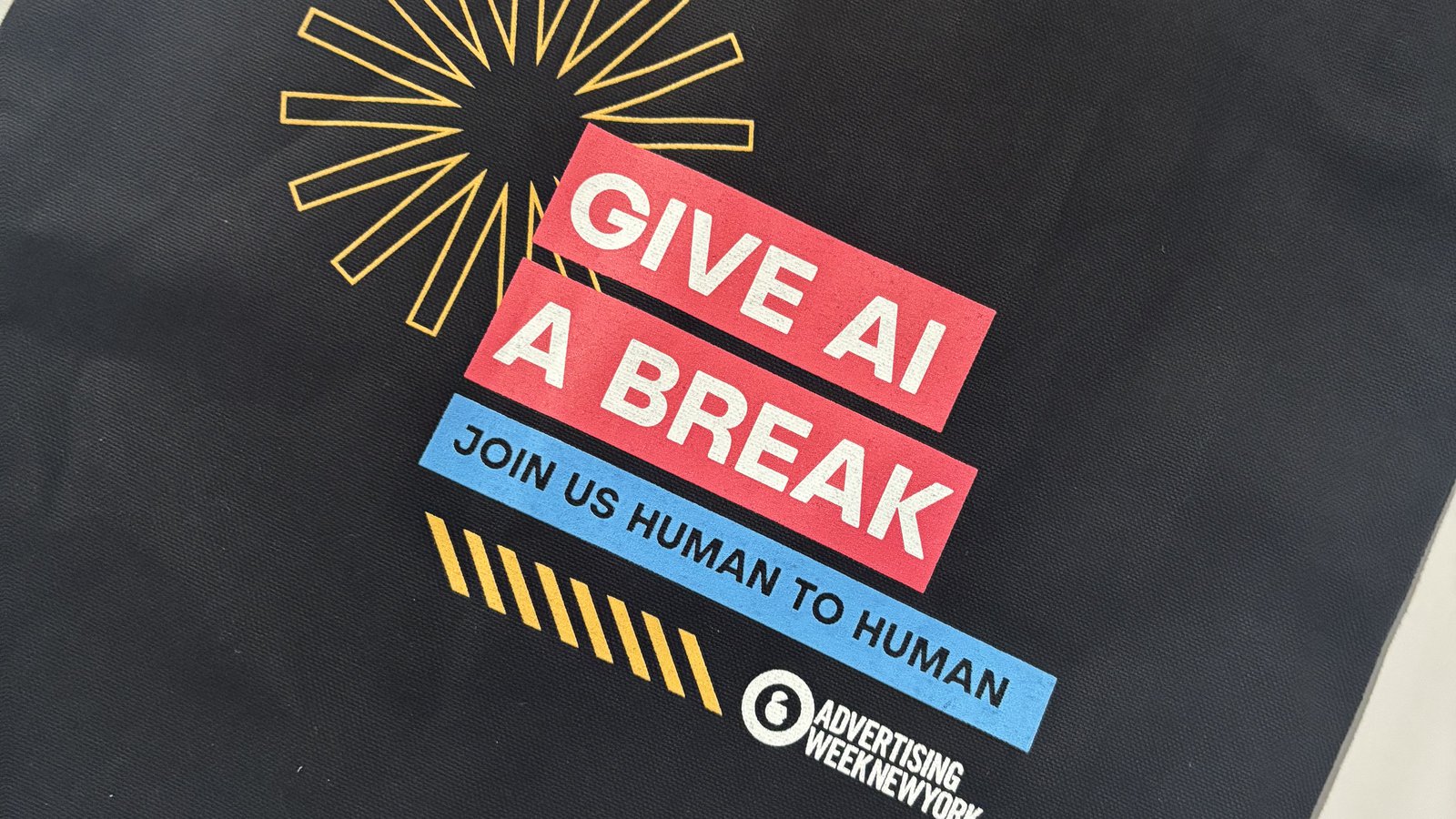
If there was one piece of advice hiding in plain sight at Advertising Week New York (AWNY) this year, it was printed on the tote bags:
"Give AI a break."
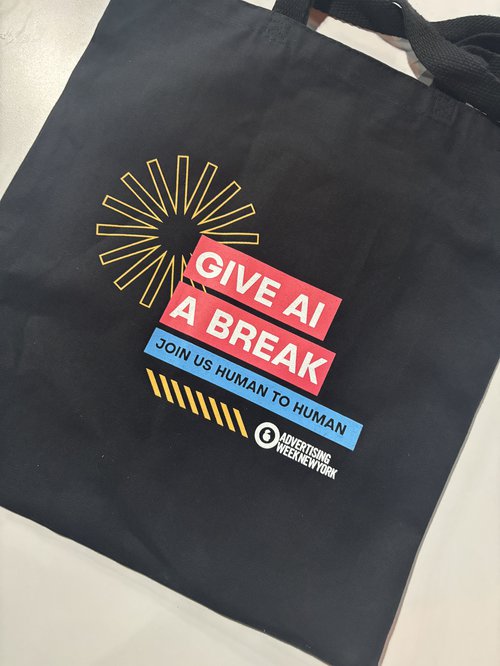
A funny line for a conference where AI appeared in session after session. But also, perhaps unintentionally, a pretty good summary of where the industry is right now.
AI can make things faster. It can automate, generate, target, optimize and increasingly make decisions. But as the technology gets better at doing more of the work, the value of what remains distinctly human becomes clearer: context, taste, trust, relevance, community, relationships and experiences people actually want to be part of.
Across the week, the conversation kept circling back to one question: How do we create things people actually want to connect with?
The creator economy is becoming a relationship economy
We were in the room Monday when Dhar Mann, AWNY's inaugural Chief Creator Officer, opened the week with a challenge to elevate the entire creator economy.
Creators have what brands need: trust, influence and communities that can rival traditional media properties. Brands have what creators need: budgets, products, distribution and business problems to solve.
The opportunity is in connecting those things.
Dhar's challenge: turn the relationships created at AWNY into $100 million in new creator-brand partnerships.
He also announced Creator City, a four-acre Los Angeles production campus designed to give the creator economy a physical home, the way tech has Silicon Valley and finance has Wall Street. It opens during Super Bowl weekend in February 2027.
It's a telling evolution. The creator economy may have been built on platforms, but its next chapter is increasingly about infrastructure, IP, business and relationships.
Attention is not the same thing as impact
The conversation is moving beyond “how much attention did we get?” toward a harder question:
Was it the right attention, in the right context, for the right audience, and did it actually do anything?
Attention shouldn't be treated as a universal score. Different creative has different jobs. The bigger opportunity is to start with the creative, audience and desired outcome, then find the moments where those things have the greatest chance of connecting.
Which brings us to relevance.
Relevance is getting harder (old news!)
Audiences don't behave like clean segments. People move between interests, communities, platforms, contexts and moments.
The better question isn't simply who are we trying to reach?
It's where are they, what are they doing, what do they care about, and why would this matter right now?
The thinking is marketers should move beyond just reach and demographics and toward context.
If the audience hasn't changed but the moment has, the creative opportunity can change dramatically.
Better inputs produce better outputs.
The IRL comeback isn't really a comeback
Across the week, there was a clear appetite for experiences that couldn't simply be replicated through a screen: pop-ups, dinners on the court, invite-only communities and physical experiences built around participation.
The thinking was simple: make something worth coming to, and you've made something worth sharing.
The digital layer comes after.
And perhaps that's the bigger AWNY takeaway. When every feed is full and AI can generate an infinite amount of content, actually being somewhere, with other people, starts to carry more weight.
And that brings us back to the tote bag.
Maybe “give AI a break” is exactly the point
The irony of AWNY 2026 is that AI was everywhere.
The most consequential conversations weren't necessarily about the newest AI tool. They were about what technology is making more valuable by comparison:
Trust. Context. Community. Human connection. Good taste. Being in the room.
And brands that understand that attention isn't the destination. It's just the beginning of a relationship.