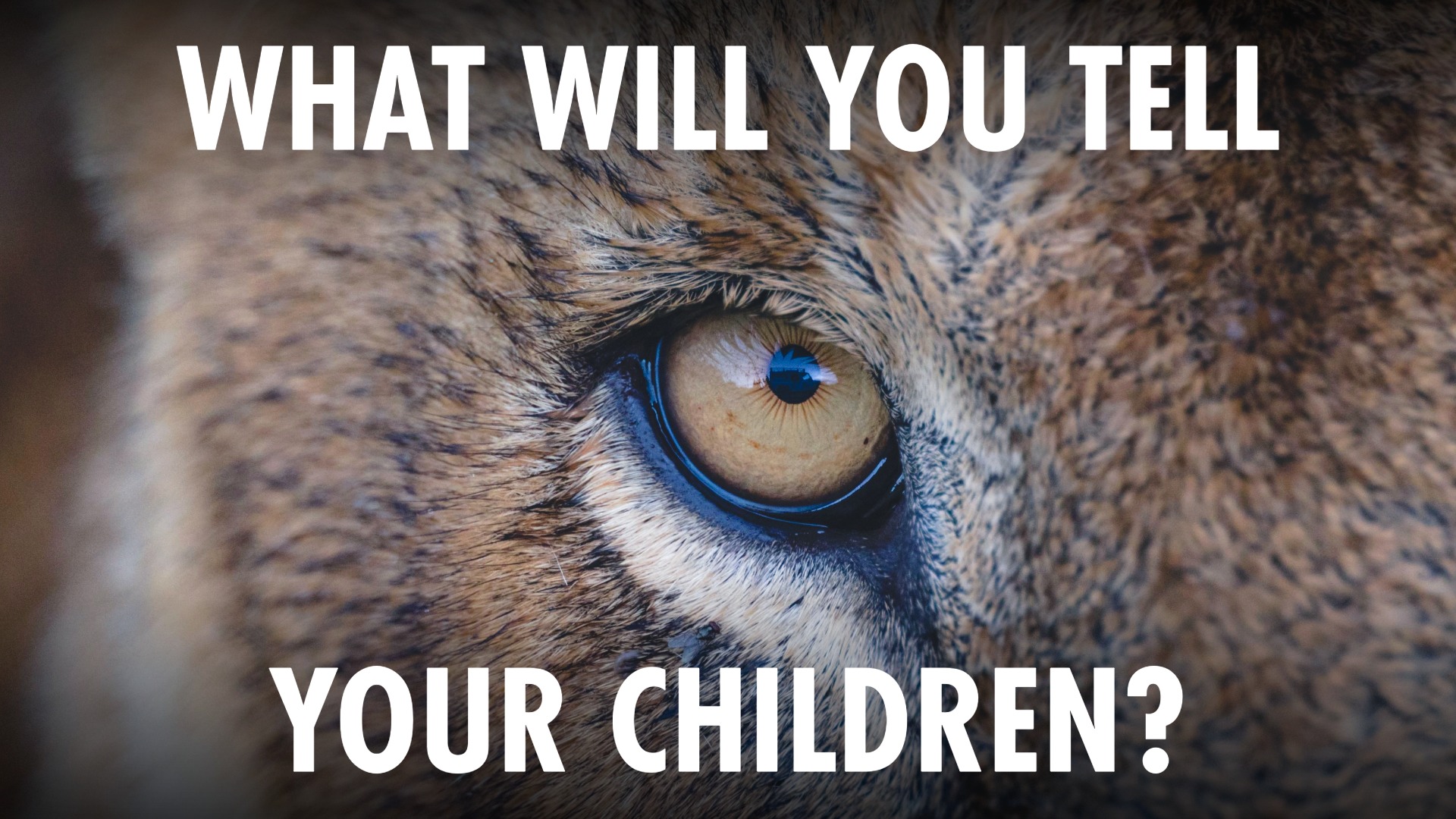
What Will You Tell Your Children? was created for Born Free’s Footsteps to Freedom fundraising gala and would be shown immediately before the auction.
We did not want to make a conventional charity film that explained our work, listed achievements or asked directly for money. Instead, we wanted to create a moment of reflection around one simple question: if we allow wildlife to disappear, what will we tell the generations who come after us?
Wildlife loss can feel distant or overwhelming. Our aim was to make it personal and immediate by asking the audience to imagine a future in which children want to know where the animals went, why they were not protected and why no one stopped it from happening.
In the film, “your children” is symbolic. It represents the next generation, whether or not we are parents ourselves, and the people who will inherit a world shaped by the choices we make today.
Emotionally, we wanted the audience to feel the sadness of what could be lost, but also the possibility that the outcome is not yet fixed. There is still time to stand up and make a difference.
The film’s role was to create that connection immediately before guests were given a practical opportunity to act: to bid and give generously in support of Born Free’s work for wildlife.
We came up with the concept and wrote the script with the gala audience and the precise moment of screening in mind. The film would be played immediately before the auction, so it needed to change the mood in the room without feeling like an overt fundraising appeal.
From the outset, we wanted it to feel authentic. The contributors are Born Free conservationists, animal carers and educators, rather than actors or presenters. Their words were filmed over time, often between other shoots, while we were already visiting Born Free projects. This allowed us to feature colleagues in several countries and real locations without organising a separate international production and additional hefty costs.
Filming people who are not used to performing to camera can be challenging, particularly when time in the field is limited. We sent the script well in advance and divided it into short sections that were easy to learn and deliver. We filmed on a DJI Pocket Osmo, which is small and unintimidating but produces excellent 4K footage. It helped contributors feel comfortable and allowed us to work quickly without a large crew.
The children’s voices were essential to the opening. They belong to the director's niece and nephew, whom she recorded on the same Osmo in the back of her car at a rugby match. They were paid £10 each in sweet money and took their roles very seriously.
We knew the film had to end with our co-founder, Dame Virginia McKenna. Her voice connects Born Free’s history with the future we are still fighting to protect. She recorded her contribution at home.
Once I had gathered the material, we worked with freelance editor David Davidian, with whom the director has collaborated for many years. Our biggest creative challenge was finding the right pace. We needed the film to build emotionally without becoming sentimental or telling the audience what to feel.
We chose every image carefully and allowed space and silence to carry some of the emotion.
The result brought together people, voices and locations filmed at different times into one coherent story.
The response was palpable. Guests watched in complete silence. For those few minutes, the pace and atmosphere of the evening changed.
The film was followed immediately by the fundraising auction. By the end of the evening, Born Free had raised more than £250,000, a record-breaking result for the charity.
We would not claim that the film achieved this alone. The total reflected an enormous collective effort by our fundraising and events teams, the hosts and auctioneer, those who donated prizes and, above all, our extraordinarily generous guests.
But the film had been given a very particular role. It needed to remind people what was at stake just before they were invited to help. The response that followed showed that its message had landed.
What matters to me is that we achieved this without making a direct appeal. After imagining a future in which they might be asked why people failed to protect wildlife, guests had an immediate opportunity to write a different answer. They acted with extraordinary generosity.
Although created for the gala, the film now has a life beyond that evening. It has been shared through Born Free’s website and YouTube channel, and has been adapted for social media, supporter communications, future events and potential cinema use. [bornfree.org.uk]
The question at its heart does not expire. One day, future generations may ask what we did while we still had a choice. The film asks all of us to consider what we want our answer to be.