Pls.Find is a social experiment from Upworthy built around a simple question: Can we use social media to catalyze collective action rooted in empathy?
Our objective was to build a community that didn't just engage with stories of human connection, but actively helped create their endings.
Pls.Find helps people reconnect with unforgettable individuals and meaningful objects they've lost, what we call “mysteries of the human heart.” A long-lost teacher who changed someone's life. An irreplaceable cello bow. A stranger whose small act of kindness on 9/11 was remembered for decades.
For each mystery, we invite the internet to help solve it.
Our goal was to transform the behaviors people already use every day on Instagram, including commenting, sharing, tagging, researching and connecting, into a form of collective action. Rather than treating community engagement as a metric, we designed it to be the mechanism through which impact happens.
We wanted to create an online community rooted in empathy, generosity and a shared sense of purpose: strangers giving their time, knowledge and networks to help someone they've never met find connection, gratitude or closure.
Ultimately, Pls.Find set out to demonstrate a different possibility for an online community. What if the internet's collective power wasn't just used to make something go viral, but to help someone? By designing social media around human values rather than attention alone, we hoped to turn an audience into a community, and a community into a force for good.
To build a community around helping strangers, we first needed to give people something worth helping with.
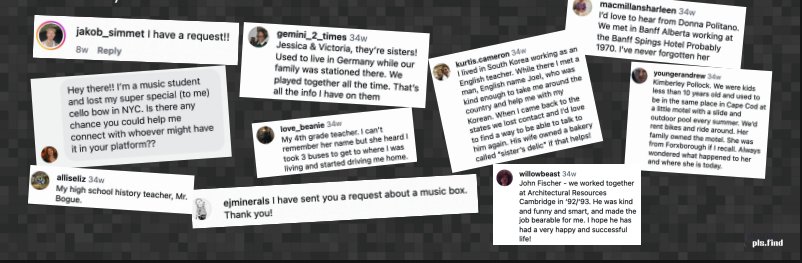
Upworthy and Pls.Find seeded the experiment on Instagram, asking their combined audience of 5M+ people a simple question: Is there someone from your past you wish you could contact again, but have no idea how? Or something meaningful you've lost and never stopped thinking about?
Hundreds responded, sharing deeply personal stories of gratitude, unfinished connections and moments that had stayed with them for years.
We followed up through DMs to understand each story, then conducted interviews to assess which searches felt potentially solvable. From there, we turned selected stories into something intentionally different from traditional social content: an open invitation to participate.
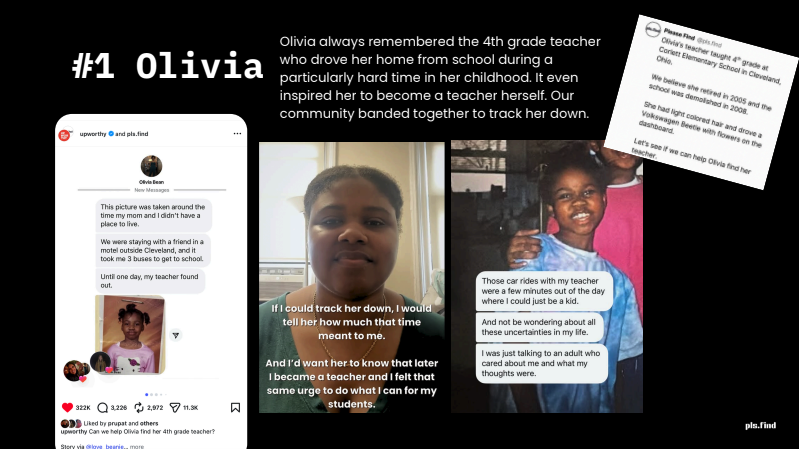
Each Pls.Find story gave the community a mystery and the clues available to solve it. DM screenshots established authenticity. First-person interviews explained the emotional stakes. Posts shared identifying details and direct calls to action. Stories provided updates as leads emerged.
Then we handed the search over to the internet.
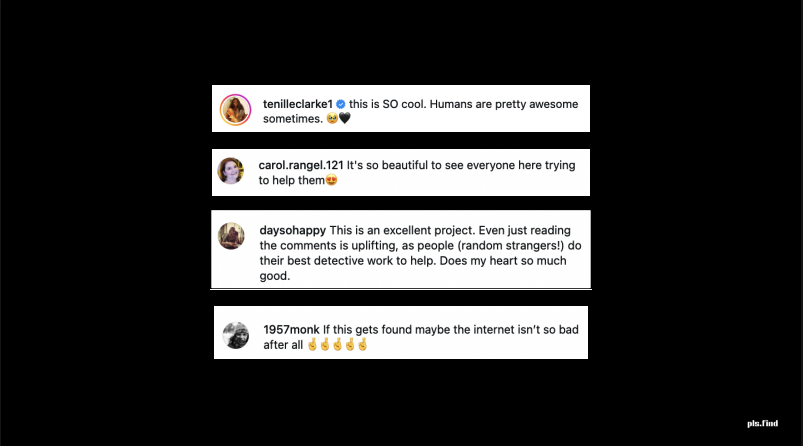
Followers became a distributed search party, digging through archives and LinkedIn, contacting former colleagues and institutions, tagging people who might know someone, sharing posts into relevant communities, and surfacing leads we could never have uncovered alone. The comment section wasn't simply a place to react to the content. It became a working space where strangers collaborated toward a shared goal.
That participatory structure was essential because our biggest challenge was also fundamental to the concept: we couldn't guarantee an ending.
We were searching across decades, often with incomplete names, fading memories, limited photographs and objects that could be anywhere. Instead of manufacturing resolution, we invited the community into that uncertainty. Each new lead could change the direction of a search, and when progress happened, we brought the community along through real-time updates.
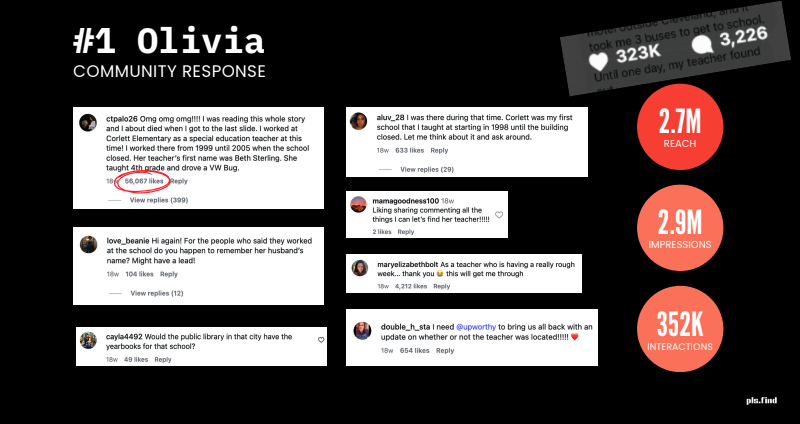
The approach produced extraordinary acts of collective effort. For Olivia, commenters identified former school employees, suggested searching yearbooks and libraries, and surfaced the lead that helped locate the fourth-grade teacher whose kindness had inspired Olivia to become a teacher herself. For Grace, musicians offered their networks, strangers volunteered to search locally, and followers even offered to collectively fund a replacement for her lost cello bow. Eventually, Uber saw the story and offered to pay for a new one.
What makes Pls.Find unique is that community engagement isn't the response to the work. It is the work.
We took familiar social behaviors and gave them a pro-social purpose. A comment can become a clue. A share can reach the right person. A tag can reconnect two lives.
People don't just follow Pls.Find's stories. They help complete them
We set out to answer one question: Could social media catalyze collective action rooted in empathy? The results answered yes, not only in reach and resonance, but in real-world impact.
Pls.Find grew to 30K followers, averaging approximately 150K engagements and 2M impressions per post, all organic, with no paid media. Olivia's search alone generated 2.7M reach, 2.9M impressions and 352K interactions; Anita's generated 4.6M reach, 5M impressions and 305K interactions.
But for Pls.Find, engagement isn't simply a KPI. It's a catalyst for collective action.
Across searches, strangers volunteered their time, knowledge and networks to help people they'd never met. They researched names, contacted organizations, amplified calls for help and surfaced real leads.
That collective effort helped locate Olivia's long-lost fourth-grade teacher, whose kindness inspired Olivia to become a teacher herself. When Grace's beloved cello bow couldn't be recovered, the community's amplification reached Uber, which offered to fund a replacement.
These outcomes demonstrate that the community's engagement is not performative. It translates into meaningful action and tangible results.
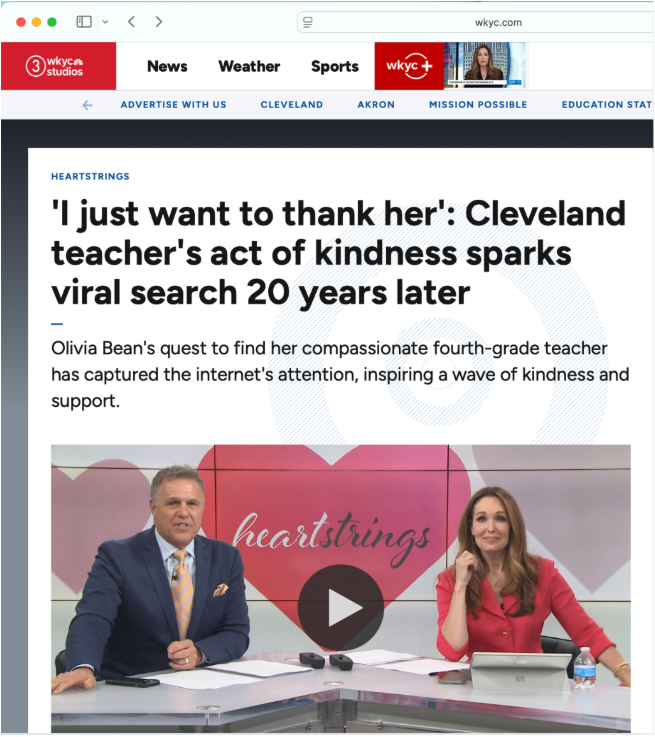
The stories also generated earned media interest from NPR, The Washington Post, BBC and NBC, bringing even more people into the community.
That's our most meaningful measure of success: we turned an audience into a community, and engagement into meaningful action. A comment can become a clue. A share can move a search forward. A tag can reach the right person. We didn't just build an engaged community. We gave engagement a purpose.