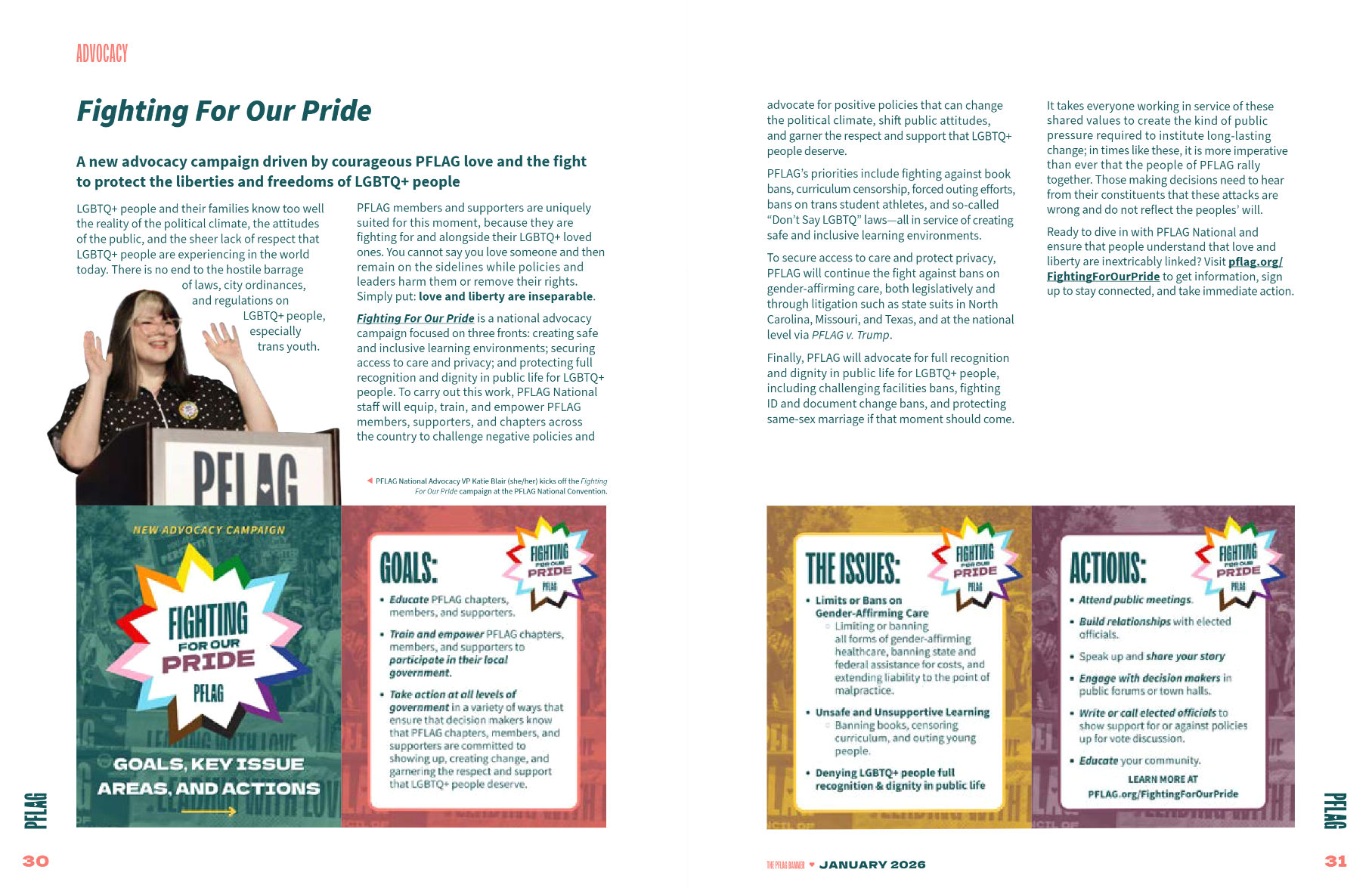
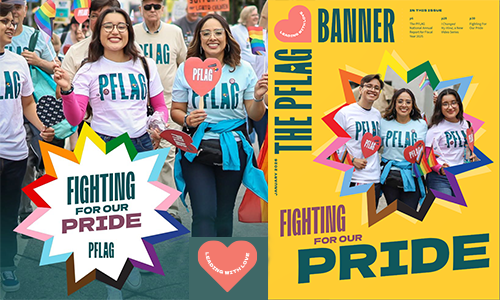
PFLAG National launched Fighting For Our Pride to combat the escalating wave of legislation and rhetoric threatening LGBTQ+ people and their families. In 2026 alone, more than 525 anti-LGBTQ+ bills have been introduced across the country. PFLAG’s membership includes parents, families, and allies of LGBTQ+ people—voices that carry moral authority in policy debates. By galvanizing their love into organized advocacy, our campaign reframed the public conversation around "parental rights" to reflect what that truly means: the right to love, affirm, and defend one's children. These 550K+ members and supporters include national members, plus the leaders and members of the PFLAG Chapter Network of over 360+ local chapters in every state across the country. Community engagement is CRITICAL in this work. We focused on three frontline battles: creating safe and inclusive learning environments by fighting book bans and curriculum censorship; securing access to care and opposing bans on gender-affirming care; and protecting full recognition and dignity in public life for LGBTQ+ people.
PFLAG National enacted a campaign with the following objectives:
The Fighting For Our Pride campaign began with identifying where the fight was most urgent on a local level, which was informed by tracking legislation, city ordinances, and school board policies nationwide. PFLAG National utilized the Movement Advancement Project (MAP) as a central resource for breaking down policies state-by-state and using MAP’s messaging guides on how to talk about these issues. MAP lists the states with healthcare bans, when they go into effect, and which have been blocked in court.
With local priorities identified, we created and distributed a series of guides with essential background information, outlined in a straightforward format. Our Advocacy team overviewed the roles of governing bodies, such as school boards, library boards, city councils, and state legislatures. This breakdown detailed how elected officials shape the daily lives of LGBTQ+ people and their families by setting policies, approving budgets, and determining whether communities are welcoming and safe. Understanding how these governing bodies operate is crucial for LGBTQ+ individuals and allies to effectively engage in decision-making processes.
Our action-oriented guides provided a playbook for meeting with elected officials, such as utilizing personal stories to discuss an issue and making the ask to support or oppose legislation. We also offered best practices for participating in town halls and meetings for school boards, library boards and city councils, as well as sample scripts for calling or emailing lawmakers.
To bring Fighting For Our Pride into the cultural sphere, PFLAG National enacted a multi-pronged marketing and communicaitons strategy to introduce our rally cry to a broad range of audiences.
A major milestone was our main stage panel discussion about safe and supportive learning at the 2026 SXSW EDU Festival. Moderated by Pulitzer Prize-winning journalist and The 1619 Project creator Nikole Hannah-Jones, Beyond Bans: Defending LGBTQ+ Stories & Literary Freedom panel featured an extraordinary lineup including bestselling author Casey McQuiston, American Library Association President Sam Helmick, and PFLAG National CEO Brian Bond—a group representative of PFLAG’s coalition building.
The campaign gained additional credibility through earned press coverage featuring interviews with PFLAG National leaders and Advocacy leadership as well as supporting voices like McQuiston and Helmick. On PFLAG National’s owned channels, we activated a continuous cadence of newsletters and social media content to uplift the campaign. We also leveraged prominent supporters, including actor Khary Payton, who penned an e-newsletter for Father’s Day sharing his own experience as a proud father of a trans son. His powerful and endearing testimony amplified the campaign and served as a fundraising call.
The challenge—and threat—throughout the campaign has been the unrelenting wave of laws and ordinances that demands a nimble and adaptive approach. We met that challenge by building a flexible infrastructure that can respond to an ever-changing political environment, while keeping communities focused, resourced, and empowered to act. Matching the “flood the zone” strategy, the campaign’s playbook enables the fight to exist both in physical spaces—from local PFLAG meetings to global conferences and civic spaces across America—as well as press coverage, social media, stages and podcasts.
Fighting For Our Pride has driven meaningful, measurable growth in LGBTQ+ advocacy across the country.
Meeting our objective of engaging more chapters and individuals, participation in advocacy activities among the PFLAG Chapter Network, members, and supporters has increased by approximately 35%, including engagement in trainings, direct lawmaker outreach, and state-based efforts like statehouse days and rallies.
By creating an actionable and digestible set of guides, PFLAG National supporters have made more than 11,000 direct touch points with lawmakers through outreach and engagement, trained over 750 supporters to advocate at their state legislatures, and had more than 200 show up in person at statehouses to fight for LGBTQ+ rights.
Amplifying the local grassroots organizing, we secured feature stories on the campaign in LGBTQ Nation and The 19th, and we leveraged the high-profile SXSW panel to secure interviews with People Magazine, Dallas Voice and News Is Out, which resulted in syndication across several local LGBTQ outlets. The campaign was further embodied by prominent supporters like McQuiston and partners like Helmick.
The campaign’s digital channels have converted on-the-ground advocacy into sustained engagement. Through dozens of action alerts and emails, PFLAG National reached 74,000 supporters, achieving a 35.4% average open rate and 2.4% click-through rate—demonstrating a highly activated audience ready to engage. On social media, 45+ posts drove over 8,500 engagements at a 5.8% average engagement rate, reflecting strong community response and momentum across platforms.
Together, these results reflect a campaign that successfully transformed love into action; mobilizing families and allies at a scale that is shifting both the political conversation and the ground-level response to anti-LGBTQ+ legislation.