While brand awareness for Make-A-Wish was high, many supporters did not see a clear or accessible role for themselves in the mission. The challenge was to close the gap between passive awareness and active participation – transforming supporters from observers into contributors.
The objective was to shift community engagement into an inclusive, participatory movement, inviting individuals to see themselves as essential to the mission, not just supportive of it. Many potential supporters were inspired by the brand but lacked clarity on how to personally contribute, creating a disconnect between affinity and action.
Through the “WishMakers Wanted” campaign, Make-A-Wish set out to build a community where every action – whether donating, volunteering or advocating – was accessible, visible and valued. By redefining a WishMaker as anyone who takes action, Make-A-Wish transformed participation from a role reserved for a select few into an identity anyone could embrace. The campaign broadened access to the mission and made engagement feel authentic, attainable and personally meaningful - allowing more people to see themselves as active contributors to bringing wishes to life.
Ultimately, the goal was to foster a community-driven movement at scale, where individuals felt a genuine sense of belonging, ownership and connection to the mission. By helping people see how their contributions directly support wish kids, the campaign aimed to strengthen connections among supporters and empower more people to take meaningful action in bringing wishes to life for children with critical illnesses.
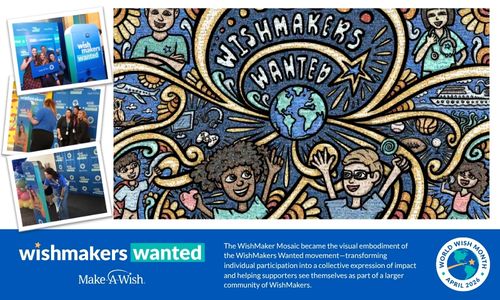
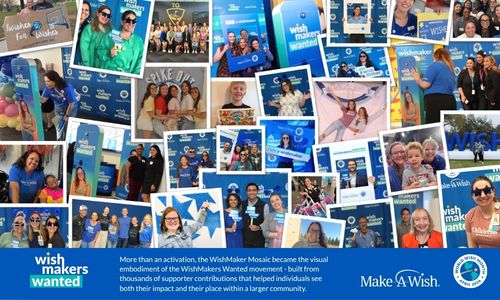
At the heart of the campaign was the WishMaker Mosaic - a dynamic community experience that transformed individual participation into a collective expression of impact. More than an activation, the Mosaic became the visual embodiment of the WishMakers Wanted movement, allowing supporters to see their personal contribution reflected within something larger than themselves. Built from real photos and stories submitted by supporters nationwide, it made individual impact visible and reinforced a powerful truth: every action, no matter how small, helps bring wishes to life.
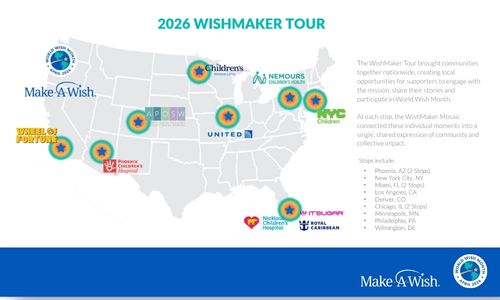
The Tour transformed the Mosaic from a digital experience into a living community, giving supporters the opportunity to participate alongside fellow WishMakers and witness collective impact in real time. Prioritizing depth over scale, stops were intentionally smaller and more immersive, enabling more meaningful engagement. The Mosaic became one of the campaign's top-performing digital experiences, generating nearly 9,000 direct interactions and engagement rates approximately 35% higher than other microsite destinations.
Participation extended beyond the experience itself, with a 47% increase in participants sharing photo submissions on personal social channels. Through social amplification, Mosaic content generated more than 95,000 impressions, transforming localized interaction into broader community participation.
This evolution repositioned the Tour from a series of events into a strategic participation engine. More than 850 supporters engaged across stops hosted by IT’SUGAR, Royal Caribbean and United Airlines, bringing together employees, customers and local communities. For the first time, the campaign expanded into hospital environments, extending participation beyond traditional supporter audiences to include pediatric medical professionals. This created new opportunities for connection between healthcare partners, wish families and supporters while helping strengthen referral awareness for eligible children.
Physical and digital experiences were intentionally designed as a connected system, making participation accessible and shareable. Supporters could submit photos and messages, see their contributions appear in real time within the Mosaic and share their involvement across social platforms—creating a cycle in which participation fueled storytelling, storytelling inspired additional participation and community members became advocates who expanded the movement through their own networks.
Equally central was a highly intentional storytelling strategy. WishMakers Wanted was powered by real stories from volunteers, donors, fundraisers, medical partners and community members. Each year, the campaign features a diverse set of WishMakers, representing different roles, identities and pathways into the mission. This intentional representation helped audiences recognize themselves in the community and identify an authentic way to get involved.
These stories were amplified through digital, video, social and PR channels and paired with wish kid stories to connect action directly to impact. By centering the voices of the community itself, WishMakers Wanted transformed storytelling into a participatory engine that strengthened engagement, amplified authentic voices and fostered a sense of belonging at a national scale.
“WishMakers Wanted” successfully transformed community engagement from something people supported into something they actively identified with. By making participation visible, the campaign built a nationwide community of WishMakers who saw themselves as contributors to a movement. In Year 3, the campaign generated 4.2 million social engagements and hundreds of volunteer sign-ups, demonstrating that audiences were not only consuming content but actively contributing to the mission.
This engagement was driven by a connected participation system linking digital, social and in-person experiences. The WishMaker Mosaic enabled supporters to contribute photos and stories in real time, turning individual actions into shared contributions, while the 12-city Tour extended the experience into hospitals, corporate spaces and local communities. Together, these elements created a continuous participation loop in which individuals were inspired to act, saw their contributions reflected and shared their involvement, amplifying reach through authentic, user-generated content.
Participation extended globally, with engagement from all 57 U.S. chapters and 37 international affiliates, demonstrating the campaign’s ability to unite a highly distributed audience. These outcomes reflect more than increased engagement - they represent a meaningful shift in behavior. Supporters moved from observing the mission to actively contributing to it, sharing their stories and inviting others to participate.
“WishMakers Wanted” demonstrated that authentic community is built when people can see themselves in the mission and witness their impact. By making participation visible, inclusive and deeply personal, Make-A-Wish transformed supporters into a nationwide community of WishMakers - demonstrating that when people are invited, they become powerful advocates for change.