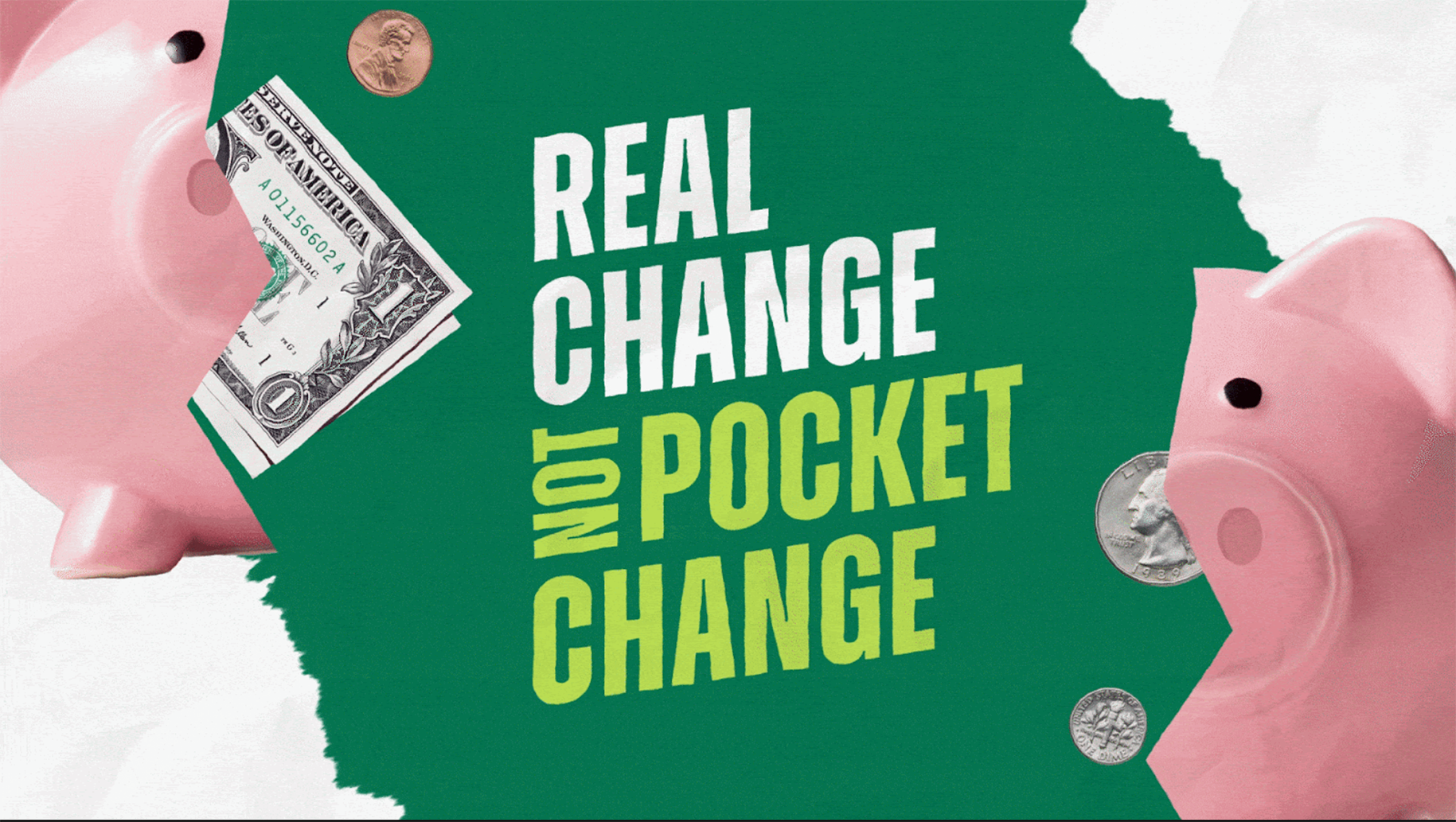
As costs kept climbing and wages stalled, State Voices saw the same story playing out across its network: working people doing everything right and still falling further behind, while politicians offered headlines instead of relief. Partnering with Fenton, State Voices launched Real Change, Not Pocket Change to shift that conversation from vague promises to real, material, immediate wins. The name came out of an iterative naming and message testing process, rising to the top for how sharply it captured a public mood that was fed up with an economy asking more and delivering less. The campaign centers the voters hit hardest and heard the least, which are working-class communities and voters of color who’ve spent years watching the cost of living outpace their paychecks. Building on State Voices’ first-ever nationwide campaign to drive BIPOC political participation, Vote For Something, this was the network’s next rallying cry, one built specifically around economic justice heading into a consequential 2026 election. The goal was to give State Voices’ 25 state coalitions and 1,200 partners a bold, ready-made identity they could carry directly into their own communities, whether that’s a rally in Seattle or a state legislative session hundreds of miles away, and turn shared frustration into a shared demand.
Since 2022, Fenton has built and sustained the national narrative infrastructure for the State Voices Network, developing research-backed messaging and creative that individual state coalitions adapt across battleground states and the South. Real Change, Not Pocket Change extended that work with a campaign built to travel - a messaging guide grounded in lived experience rather than policy jargon, a bold visual identity anchored by a stark wordmark and piggy bank imagery, and a full creative suite spanning social graphics, banner ads, protest signage, merch, and a dedicated campaign hub at statevoices.org/real-change.
We launched publicly on October 7th through a coordinated push across State Tables and partners, giving coalitions a ready-made toolkit of social copy and graphics they could adapt for their own communities and even localize, like Seattle’s own “Seattle Deserves” activation. Just days later, we wove the campaign directly into No Kings Day on October 18th, giving state tables custom protest signage and social assets built for that moment’s national momentum.
The real challenge was building something urgent and specific enough to hold up across dozens of different state contexts, on a limited runway, and without the scope of a traditional national ad rollout. So we focused where it mattered most: getting the narrative and visual foundation strong enough that any state table could pick it up and make it their own, whether that meant a picket sign, a t-shirt, or a localized social post. We’re continuing to build on that foundation with a virtual rally and a first-ever Real Change Film Club planned for later this year, both designed to keep economic justice front and center heading into 2026.
Real Change, Not Pocket Change gave State Voices’ network a shared identity right when it needed one. Messaging and creative from the campaign’s online resource hub have been picked up by over 800 frontline organizers, showing up on picket signs, social feeds, and local activations from Seattle to state capitals nationwide. Earned media efforts landed the campaign coverage on economic justice in The Guardian and Word in Black, along with an op-ed in Inside Philanthropy, while State Voices President and CEO Alexis Anderson-Reed carried the campaign’s message directly into press interviews about what working people deserve after a brutal year of rising costs.
This builds on Fenton’s long running partnership with State Voices, including preparing Alabama Forward for the Allen v. Milligan voting rights case they brought to the Supreme Court and won, and securing over 50 media placements for State Voices in outlets like The New York Times, the Associated Press, NPR, and MSNBC, and key local and Black affinity outlets.