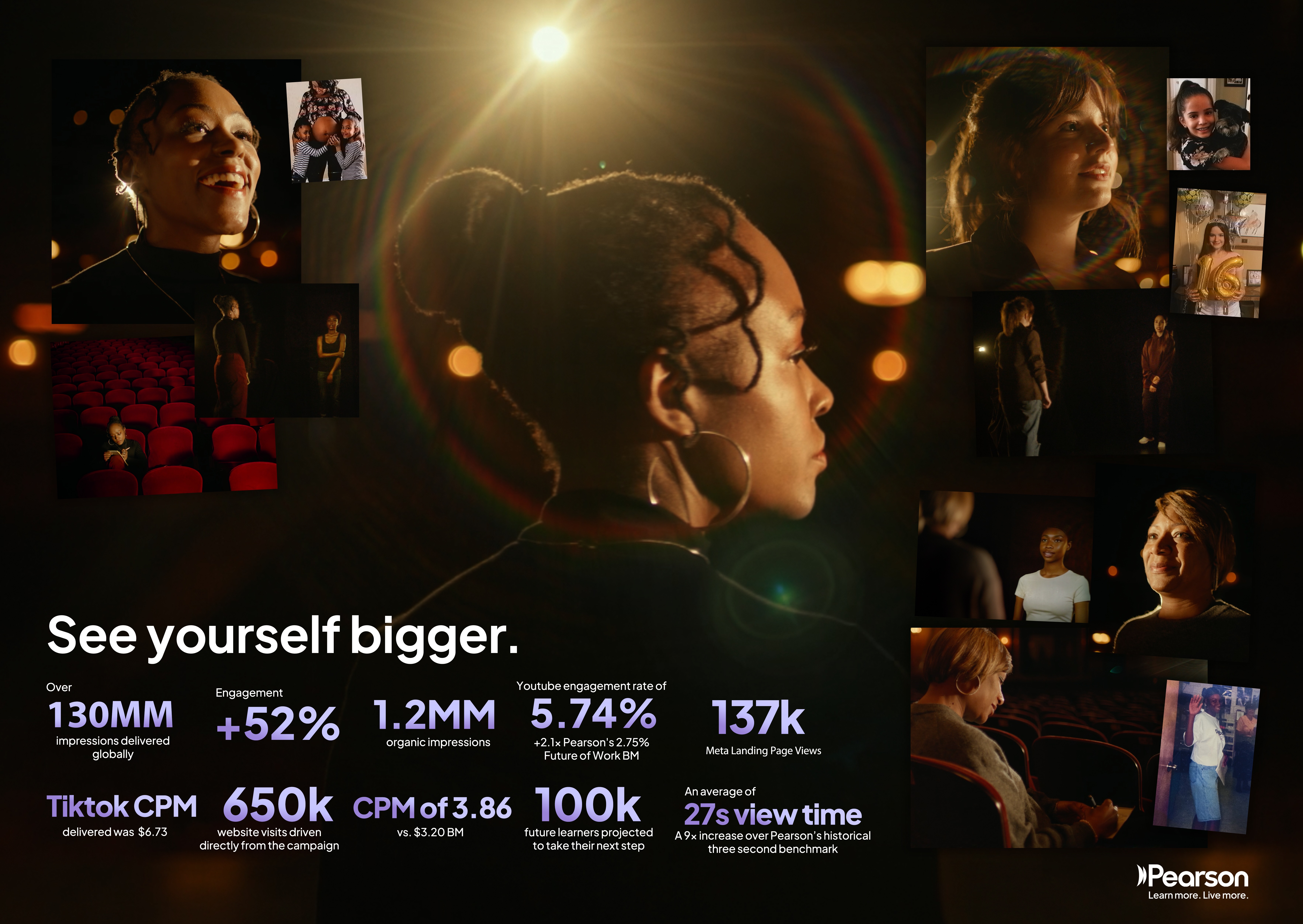
The education sector has long positioned learning as a transaction, something to complete in pursuit of a diploma or a job. It has been reduced learning to a finite task rather than a fundamental part of being human. Pearson set out to challenge this narrative. In March 2026, Pearson launched “See Yourself Bigger”—its first global campaign following a transformation from a traditional education company into a lifelong learning partner.
As AI reshapes education and work, the pace of change has never been greater. In this new reality, learning is no longer a phase, it is a lifelong necessity. “See Yourself Bigger” harnessed this moment, using cutting-edge AI to create a dialogue between real people and their younger selves—bringing to life how learning compounds over time and unlocks possibility.
The work transcended traditional marketing, replacing the category's standard "how-to" messaging with a profound "why" and reinforcing Pearson’s purpose: helping people realize the lives they imagine.
The objective was to unify four elements into one globally consistent and human idea:
The work addressed four challenges:
Success was measured in three ways:
Pearson engineered an emotional time machine using Generative AI and VFX to facilitate a raw, unscripted dialogue between real learners and their past selves at the exact moment they almost gave up.
The campaign centered on three real-life Pearson students—Jasmine, Savannah, and Natosha—whose stories of overcoming profound barriers represented universal hurdles to education. While their journeys are unique, common elements, such as health, safety, and providing for family, represent real-life barriers to committing to traditional education.
With the power of AI, Pearson brought these learners face-to–face with their younger selves, creating otherwise impossible dialogue about the transformative power of education.
The work confronted a challenge with no established playbook: how do you build an AI-generated avatar of someone's younger self that doesn't feel like a special effect, but instead feels true enough that the learner sitting across from it feels genuinely seen, and true enough that an audience of strangers feels the weight of that reunion? Get the likeness slightly wrong, or let the technology feel too polished or too uncanny, and the entire emotional premise collapses into gimmick. The team had to solve this not as a technical rendering problem, but as an emotional one: sourcing real photos, voice patterns, and personal memories from each learner, then working iteratively with them to ensure the avatar carried their actual mannerisms and vulnerability—not a generic "younger self," but their younger self, specific enough to unlock real tears, real recognition, real reckoning on camera.
In a landscape riddled with skepticism of AI’s role in society, this project proves that technology is at its most powerful when it acts as a mirror. It augments the human story and grounds Pearson’s message in the lived experience of those whose lives were transformed entirely by learning. This is AI with a soul.
The campaign targeted three key audiences who collectively shape demand and perception across the education ecosystem: educators, employers, and learners .
Execution followed a launch-and-learn methodology:
The success of “See Yourself Bigger” spanned internal and external audiences, showing the universal impact of education and the powerful nature of AI storytelling.