Every February, New York Fashion Week celebrates what’s new, expensive, and trending. Runways fill with clothes people want to be seen in, while outside, in one of the coldest months of the year, thousands of New Yorkers are facing winter without warm, reliable clothing.
For The Greater Hood is Six+One’s dedicated nonprofit arm. Its mission is to restore dignity by redesigning how clothing support is delivered. To date, FTGH has clothed more than 17,000 men, women, and children, but the need continues.
The objective was to use the cultural timing of Fashion Week to make that need impossible to ignore. If the city was going to spend a week talking about fashion, we wanted to use that same moment to talk about the people who do not have the money or access to clothes themselves.
Our goals were to cut through the noise of Fashion Week with a message that could register instantly, create a simple way for New Yorkers to participate, and drive awareness, education, and donations with no traditional media budget.
Clothing was already at the center of the city’s conversation. We wanted to shift the lens without shaming the moment. The idea needed to live naturally in fashion neighborhoods, work as a public-space installation, and turn attention into action quickly. Most of all, it had to stay true to FTGH’s mission: no guilt, no pity, just a direct invitation to help fill the next hanger.
The idea was Empty Hangers.
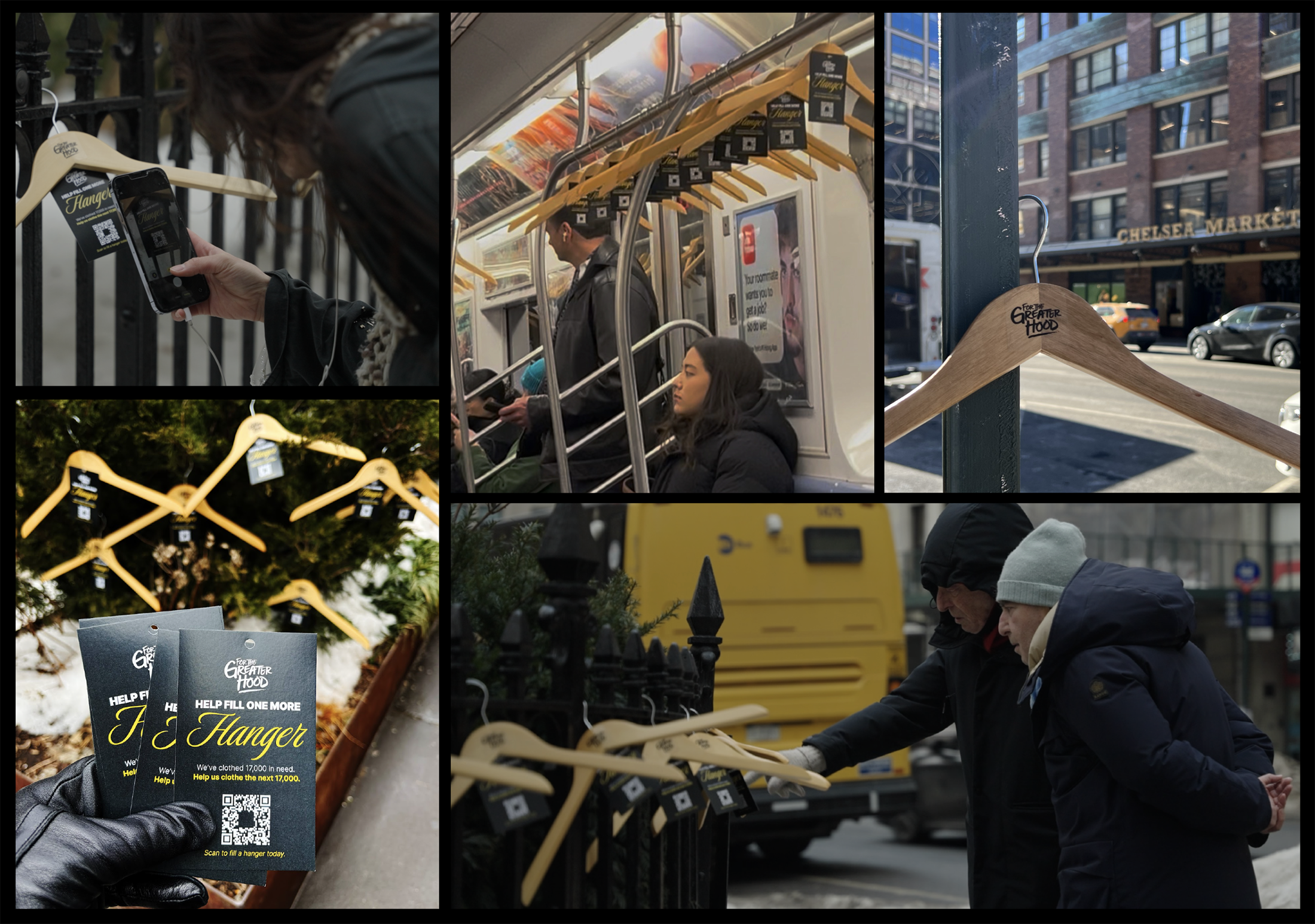
On the first day of New York Fashion Week, 17,000 empty hangers appeared overnight across New York City’s fashion neighborhoods. Each hanger represented one person For The Greater Hood had already clothed, and one more person we were asking New Yorkers to help clothe next.
The hanger was the whole idea. Fashion’s most familiar object became a physical symbol of absence. During the one week when the city is most focused on clothing, we used empty hangers to remind people of those who still don’t have enough to stay warm.
With no paid media budget, the city had to become the media plan.
The activation launched on Wednesday, February 11, 2026, across SoHo, Meatpacking, Chelsea, Flatiron, and the Garment District/Midtown, including the 34th Street corridor. These locations were chosen deliberately. They are places where fashion, retail, media, and foot traffic overlap, giving the installation physical relevance and a natural connection to the message.
The experience had three simple steps:
Spot it: a visual interruption in the street. Absence made physical.
Scan it: a QR code unlocked a short, human story from someone who had experienced FTGH’s support.
Fill it: people could donate in seconds through clear giving levels: $20 helps clothe one person, $40 clothes two, $100 clothes five.
The installation was designed to travel two ways at once: first as an in-person “spotted” moment across neighborhoods, and then as shareable content that could move throughout Fashion Week.
FTGH partnered with creators across the city to capture the installs, street reactions, and real-time sharing. This amplified the message online while keeping the original idea grounded in real public space.
The challenge was restraint. Fashion Week is loud by nature. We didn’t want to compete with spectacle by adding more spectacle. We wanted to create something quiet, stark, and easy to understand in seconds.
A hanger did that. It didn’t need to explain much. It just needed to be empty.
Empty Hangers gave FTGH a way to enter the Fashion Week conversation with no paid media budget and turn that attention into direct support.
By the end of February 2026, the campaign played an important role in FTGH’s broader fundraising efforts, which raised more than $125,000 to help continue clothing men, women, and children in need.
The success came from making the ask simple, visible, and tangible. Each hanger connected people to a real story and a clear path to give: $20 helps clothe one person, $40 clothes two, $100 clothes five. Instead of asking people to think about homelessness in the abstract, the campaign showed them exactly what their donation could do.
For us, the result was not just money raised. It was proof that a simple object, placed in the right cultural moment, could turn awareness into action. During a week built around fashion, Empty Hangers helped shift the conversation toward those going without clothing at all.
The campaign helped FTGH continue its mission to restore dignity through clothing, one hanger, one donation, and one person at a time.