Every school day, millions of children rely on school cafeterias for a significant share of their nutrition. Yet districts often lack the data, staffing, infrastructure, and practical roadmap to move beyond minimum compliance and reduce ultra-processed food at scale.
Eat Real set out to make better school food achievable, measurable, equitable, and enduring. The doctor-led nonprofit expanded a free, science-based K-12 certification model that helps school nutrition leaders assess entire meal programs, identify the highest-impact opportunities, and implement changes that work within real budgets, kitchens, supply chains, and student preferences.
From January 2025 through August 2026, Eat Real focused on four goals: reach more than one million students nationwide, help districts reduce added sugar and highly processed foods while increasing fresh, minimally processed, and responsibly sourced ingredients, build a stronger data foundation connecting meal quality with student health and learning, and elevate school food as essential public-health infrastructure.
The model was designed to scale without adding costs to school districts. By keeping certification and implementation support free, Eat Real gives high-need communities access to the same evidence-based standards, analysis, coaching, and peer learning available to larger, better-resourced systems.
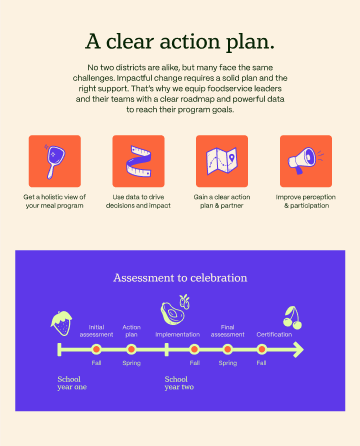
Eat Real treats school food as a systems challenge, not a one-time menu makeover. Its certification program uses 10 evidence-based standards and 34 key performance indicators to evaluate nutrition, ingredients, sourcing, preparation, waste, and food education across an entire district.
Registered dietitians review menus, recipes, ingredient lists, procurement practices, and operational data to establish a baseline. Eat Real then translates that analysis into a customized, multi-year roadmap. District teams receive hands-on support to prioritize feasible changes, including reducing added sugar, removing ultra-processed ingredients, revising vendor specifications, expanding scratch cooking, increasing local and responsibly sourced food, and improving menu variety and student participation.
The central execution challenge is that school food systems are highly constrained. Urban, suburban, and rural districts face different budgets, labor shortages,outdated kitchen infrastructure, regional supply chains, and student preferences. Eat Real does not prescribe one menu. It uses rigorous methodologies to help each district identify the operational path that can work locally.
Eat Real also built the conditions for broader systems to change. A national peer network allows foodservice leaders to exchange tested solutions and supplier insights, while district storytelling and advocacy turn individual district wins into proof points for broader adoption. School Lunch Tours, district storytelling, digital education and executive thought leadership make measurable school food progress visible to families, funders, policymakers, and prospective district partners.
During the eligibility period, Eat Real expanded across the country, including new district partnerships in Texas and San Diego County. It also secured a $3 million, three-year investment from The Dohmen Company Foundation to expand certification, implementation support, and evidence-building nationwide.
This combination of science-backed standards, practical implementation, public storytelling, and cross-sector funding turns healthier school meals from a wellness aspiration into a repeatable public-health model.
Eat Real surpassed its goal of reaching one million students, doubling its lifetime impact in a single school year. By 2026, the organization was serving more than one million students across 21 states and 1,897 schools.
That scale translated into measurable changes in what students eat. Morgan Hill Unified removed 34 pounds of sugar per student per year. Natomas Unified reached 98% locally sourced produce. Walnut Creek Unified increased meal participation by 123%. Coupeville School District built a menu made up of 78% minimally processed food.
Eat Real also turned district-level progress into policy change. Its advocacy has reached 30 million students and helped advance three successful school-food policies. In 2025, Eat Real co-sponsored and championed California Assembly Bill 1264, a first-in-the-nation law signed by Governor Gavin Newsom that establishes a legal framework for defining ultra-processed foods and phases the most harmful ultra-processed ingredients out of public school meals. Vendors will be prohibited from offering these ingredients to schools beginning in 2032, with schools required to complete the phaseout by 2035.
Eat Real also co-sponsored California’s Healthy Meals for Kids legislation, which established an added-sugar limit based on the organization’s reduced-sugar standard. That approach was later adopted nationally by USDA for the National School Lunch Program.
The organization also secured a $3 million, three-year investment from The Dohmen Company Foundation, its largest to date, to expand certification and research while keeping certification free to schools. Together, these results show Eat Real can improve children’s environments at district and policy scale.