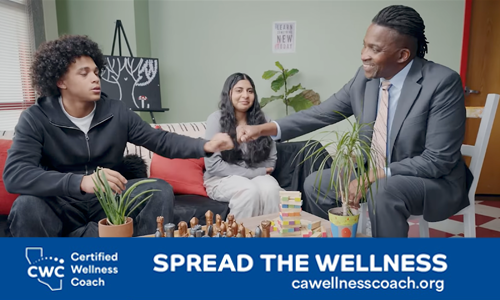
Nearly half of California's youth are struggling with their mental health, and the systems meant to catch them weren't built to handle that many. California's response was unusually bold: instead of stretching an already strained system thinner, the state created an entirely new behavioral health profession.
As part of California's $4.7B Children and Youth Behavioral Health Initiative (CYBHI), Wondros was tasked with building the Certified Wellness Coach (CWC) workforce from scratch. The goal was not marketing an existing idea, but standing up a career path that didn't exist before, defining what success in it looked like, and convincing thousands of people to be among the first to pursue it.
That meant solving two problems at once: giving candidates real reasons to commit to a brand-new role, and giving employers (schools, clinics, community organizations) reason to trust and hire Certified Wellness Coaches before they had any track record.
Our specific goals:
The hardest part of this campaign wasn't the message; it was the fact that the job didn't exist yet. We weren't selling an established career path; we were asking people to be early adopters of a brand-new credential, in a state where the people who needed it most are often the hardest to reach: rural communities, under-resourced school districts, and historically underserved populations facing the steepest mental health care workforce shortages.
So we started with research, not creative. Working with NORC, we used GIS mapping to identify where the need (and the candidate pool) actually overlapped, ran pulse surveys to baseline awareness of the role, and conducted in-depth interviews with the people who'd ultimately decide whether this mattered: prospective candidates, school administrators, parents, and youth themselves, including a youth advisory panel of high schoolers who helped us understand what would actually make a teenager trust a Wellness Coach. That research shaped everything from our branding (a deliberately warm, hopeful identity built around hope, support, and belonging) to which messages we tested with which audiences.
From there, we built a brand identity and a 360 campaign across paid, earned, owned, and in-person channels, anchored by a mission film featuring real HCAI leadership, newly certified Wellness Coaches, and the young people they serve, because no amount of audience research substitutes for hearing it from someone who's actually done the job. We paired that with statewide community engagement: showing up in person, partnering with trusted local organizations rather than parachuting in, and giving early CWCs tools to represent the role with credibility in their own communities.
The trickier challenge was that we were really running two campaigns at once. A workforce campaign doesn't work if there's nowhere for that workforce to go, so as candidate recruitment built momentum, we shifted weight toward employers (school districts, nonprofits, community health centers), making the case for hiring CWCs in parallel, so certified candidates had jobs waiting rather than a credential with nowhere to go. We've continued to adjust both audiences and creative in real time based on performance data and shifting program priorities, treating this less like a static campaign and more like an ongoing system we're tuning.
What makes this approach distinct is that human-centered design wasn't a phase; it was the operating model throughout, from the first GIS map to the latest piece of paid social. Every adjustment we've made has come from listening to the actual humans on both sides of this new profession, not just the data.
Our objective was ambitious: launch and build statewide awareness of an entirely new certification and career path, recruit qualified candidates across California, and educate employers and the public on this emerging role, and create a new community using the organic social channels we created.
The results confirm we met that objective, and then some. As of June 2026, the campaign generated over 616M impressions and 2.5M site visits, converting at 2.4% into 59.6K conversions, well above typical awareness-to-action benchmarks for a brand-new credential. That funnel directly contributed to certifying more than 4,800 Wellness Coaches across 55 of California's 58 counties, hitting our recruitment milestone four months ahead of schedule.
Social media was central to that success. Starting Facebook and Instagram from scratch, along with a LinkedIn Group for CWCs and Employers, we drove 36.9M+ Facebook impressions with a 2.2% post engagement rate, well above industry norms, and 24.5M+ Instagram views, together generating over 331K engagements. These channels didn't just build vanity metrics; they built a movement, helping engage 700+ community and stakeholder partners who amplified awareness, recruitment, and hiring efforts statewide.
The real-world impact is what makes this a true success: 745+ sites now have a Certified Wellness Coach on staff, and more than 176K California students are receiving direct support as a result. We didn't just launch a career, we used social media to build the pipeline of professionals now serving the youth who need them most, ahead of schedule and at statewide scale.