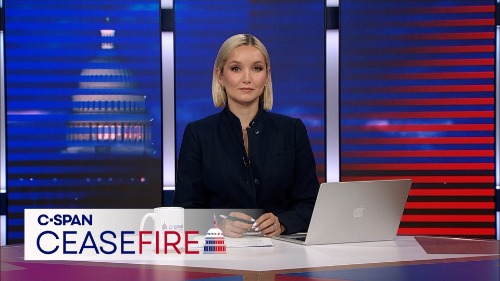
Washington is often defined by its divisions, and political television has traditionally reflected them, rewarding sharp disagreements, spirited debate and ideological clashes. C-SPAN CEO Sam Feist knew this world firsthand from years overseeing the production of CNN’s Crossfire. But he’d also spent years talking with members of Congress off camera, where he saw another side of Washington: elected officials on opposite sides of the aisle who respected each other, worked together and often called each other friends. Those relationships — and the thoughtful conversations behind them — rarely made it on air. Ceasefire was created to change that.
At a moment when political polarization threatens American democracy, C-SPAN launched Ceasefire, a groundbreaking weekly series that rejects the combative model of cable news in favor of genuine conversation across the partisan divide.
Premiering in Fall of 2025, and hosted by POLITICO's Dasha Burns, the program represents Feist’s vision of what political discourse can be when it prioritizes understanding over conflict and civility over spectacle.
Ceasefire had a simple but ambitious goal: Create a national platform where Americans could see Democratic and Republican leaders engage with one another as people—not as opponents—and demonstrate that productive political conversation is still possible. At a time when many experience politics through algorithmically curated outrage, Ceasefire offers an alternative model of civic engagement. A genuine attempt to show that disagreement and respect aren't mutually exclusive, and that authentic civil discourse in American politics is more common than the coverage suggests.
The strategy started with pairing. Feist and his team spent months identifying lawmakers, governors, and political leaders who were natural opposites on paper — different parties, different ideologies — but who had real relationships or shared interest in solving the same problems. Rather than booking guests for combat, Ceasefire booked them for candor, asking pairs to sit down and talk through the country's hardest issues without a moderator pushing them toward conflict.
To lead it, C-SPAN brought in Dasha Burns — POLITICO's Global Anchor and Playbook Co-Author, who brought journalistic credibility and who was known for sourcing across the political spectrum. Her job wasn't to referee a fight. It was to create the conditions for two people who disagree to actually listen to each other, on camera, for a full conversation instead of a sound bite.
The timing mattered. Ceasefire launched in October 2025, when political polarization and distrust were already defining much of the national conversation. C-SPAN used its unique position as a nonprofit, nonpartisan public service to create something difficult to find elsewhere in political media: a place where opposing sides could speak directly to one another without the conversation being built around conflict. The format itself was the execution strategy: a weekly series with a premiere built around real, political officials rather than pundits or surrogates. Each episode paired prominent figures from opposite parties—from former national leaders to current members of Congress—with conversations focused on the issues confronting Americans. Early pairings included governors from opposite parties discussing how they actually govern together, and former officials from different administrations comparing notes on shared challenges. Every episode was built to resist the easy TV instinct — cutting to conflict — and instead let disagreement sit alongside respect.
The format deliberately prevents point-scoring dynamics or gamifying the debate format. Guests sit at a round table with red and blue arrows pointing toward the center, while Burns sits at a white arrow, representing finding common ground rather than emphasizing division. Burns moderates the conversation between the two guests, providing context when needed, redirecting the conversation and allowing the common ground to unfold.
Because C-SPAN carries no advertising and answers to no ratings algorithm, the show could take the patience this format demanded: long-form, unedited conversation. The execution extended beyond the television broadcast. C-SPAN distributed conversations and excerpts not just on linear cable but also across its digital platforms, allowing individual moments of disagreement, agreement and unexpected connection to reach audiences well beyond the original broadcast designed to travel beyond C-SPAN's traditional audience entirely.
Across Ceasefire’s inaugural season, it did what it set out to do: put bipartisanship on screen and get people to actually watch it happen.
The premiere episode featured former Vice President Mike Pence and former Chicago Mayor Rahm Emanuel, who previously served together in Congress, and whose exchange yielded genuine moments of agreement. As Pence observed: "Democracy depends on heavy doses of civility, and maintaining the ability to find things that we can agree begins with civility."
Throughout its first year, Ceasefire built a library of 45 conversations between political opposites C-SPAN could point to as proof of concept — governors, members of Congress, and former officials from opposing parties, on the record, finding real agreement instead of performing disagreement. Ceasefire also gained a strong social media presence with 4.4 million views across Meta and TikTok.
Since its launch, Ceasefire has been featured in dozens of media outlets including AP News, Variety and The New Yorker, highlighting its unique format fostering conversation about civil discourse.
Ceasefire has created something rare in today's political media environment: a recurring space where people with fundamentally different political views sit together, listen to one another and look for areas of agreement. The program has demonstrated that civility does not require abandoning conviction, and that finding common ground does not mean pretending differences don't matter.
For C-SPAN, that is the real measure of impact.
Ceasefire is helping change what political television can look like—and reminding viewers that democracy works better when the conversation continues.